
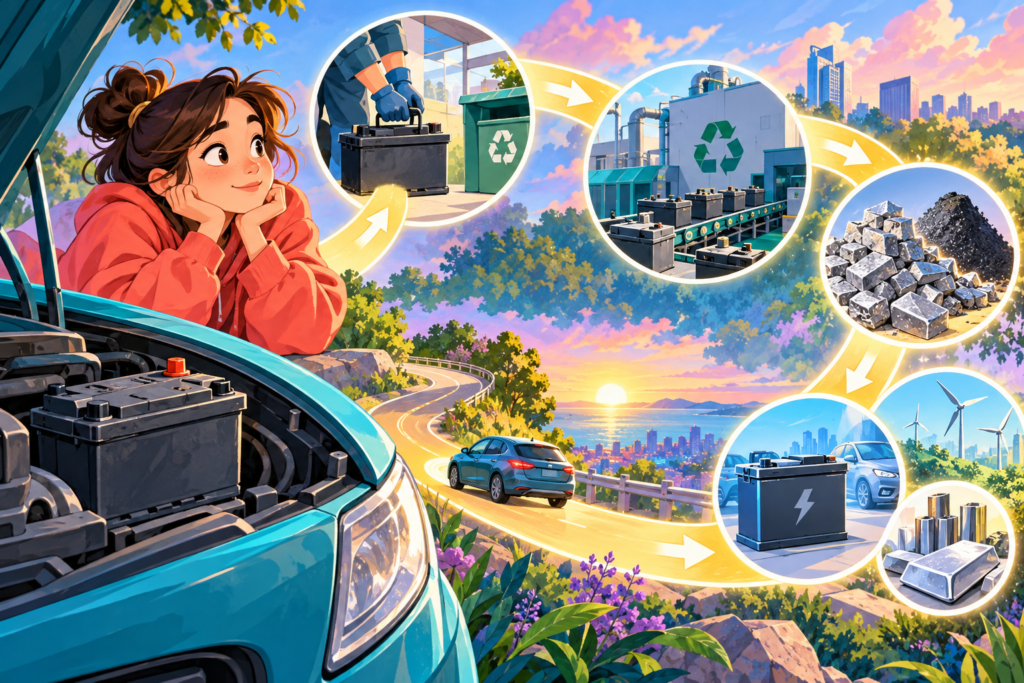
Electric cars are often introduced with a new battery and a bright showroom. What happens years later, when a battery no longer meets the demands of a vehicle? It may still contain useful materials and energy, but it also needs careful handling.
The IEA’s 2024 accounts of China discuss battery traceability and a proposal to improve repurposing and recycling. That particular proposal was described as a draft for consultation, rather than a completed regulation. Different packs may be assessed for another use or sent for material recovery. The right route depends on their condition and chemistry; “reuse” is not automatically better or safer in every case.
Reuse and recycling answer different questions
A battery can cease to suit a vehicle without becoming identical to every other retired pack. Its condition, history and design matter. Assessing it is the step that connects retirement with an appropriate next route.
Repurposing means using the battery for another task. Material recovery instead aims to retrieve useful substances through recycling processes. These are different outcomes, not two labels for leaving the same pack untouched in a new place.
The IEA’s Global EV Outlook 2024 places reuse and recycling within a wider supply-chain discussion. It also distinguishes retired vehicle batteries from manufacturing scrap. Scrap produced while making batteries can reach a recycling facility before a finished vehicle has ever used the material.
That distinction matters when reading a recycling statistic. Processing material from manufacture and processing a pack after years of driving present different histories. A large recycling capacity figure does not tell us how many old cars’ batteries have actually been handled.
Traceability addresses another part of the problem. Information about the product and its route helps connect those responsible for manufacture, use and later processing. Without that connection, the physical pack can move while useful knowledge about it becomes harder to recover.
The IEA’s account of the 2024 consultation proposal emphasises quality, safety and environmental considerations. Its draft status should stay attached to that dated example. A proposal demonstrates what was being considered at the time; it cannot establish the exact rules applying to every operator today.
For a product diagram, draw a fork after vehicle use rather than one arrow labelled “recycled”. Put assessment before the fork and different tasks after it. That simple change makes the need for a decision visible.
A successful next use also needs a suitable recipient and a workable process. Useful materials do not return to manufacture simply because they remain inside a pack. Collection, assessment and processing turn that possibility into an outcome. The battery’s later life is part of the invention’s practical story, rather than an afterthought left outside the showroom photograph.
The second half of the invention
Think of buying a gadget without knowing whether anyone can repair or recycle it. The gadget’s cleverness would be only half the story. Batteries bring that question to a much larger scale.
Do not try to open a battery yourself: the risks are real. The useful question is for manufacturers and regulators. How do they know where a pack went, what remains inside and how to keep its materials from becoming a problem?
Explore next
- Lunch delivery needs more than a drone
- Would you buy a snack from a robot?
- Could you build a robot for a teenage challenge?
Sources
- International Energy Agency: China waste EV battery utilisation specification
- International Energy Agency: Global EV Outlook 2024