
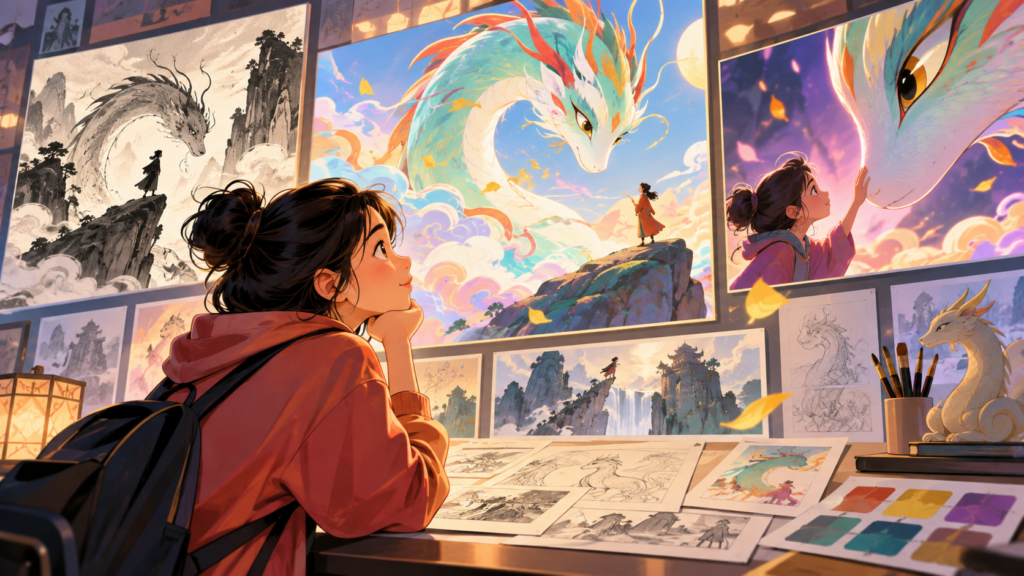
An old tale does not arrive with a fixed colour palette or camera angle. Somebody has to decide what a creature looks like, which moment deserves a close-up and how much of the story to leave to the imagination. That is why animation can make familiar folklore feel new.
Shanghai’s official Spring Festival route in 2026 included a large exhibition of Yao – Chinese Folktales, an animated anthology first released in 2023. The guide described more than 300 original artworks and production materials. Viewers could see not only finished images but traces of the decisions behind them.
A story has to choose what you see
When someone tells a tale aloud, listeners can picture the same scene differently. An animated version has to make visible choices: a particular outline for a character, a setting and a way for the action to move through it.
Those choices needn’t end the variety. The anthology format gives separate films room to approach their material differently. A viewer can encounter more than one visual language under the same collection title.
The Shanghai display included sketches from Nobody and props associated with episodes such as Jade Rabbit and Little Snow. These are different kinds of production evidence. A sketch records a drawn decision; a prop shows something made for the work.
Neither automatically reveals a rejected idea. Some materials may belong closely to the final version. The useful question is how an object or drawing relates to the moving image, rather than assuming every preliminary piece is a secret alternative.
You can explore that relationship with a familiar story of your own. Choose one scene and draw it from two viewpoints. A close view might emphasise a character’s reaction, while a wider one explains where the action takes place. The words could remain the same even though the emphasis changes.
Animation also unfolds in time. A still drawing lets somebody look for as long as they wish; a film decides how long an image stays before the next one arrives. Showing a detail, holding it or moving past it becomes part of telling the story.
That makes production material worth looking at after seeing the finished work. It slows down something the film carries quickly past. You can begin to recognise that a remembered scene is not just the old tale appearing again, but a particular group of makers deciding how to let it appear.
The drawings before the screen
Production art can make a character seem less inevitable. There may be experiments with expression, costume or background before the version that appears on screen. Once you know that, a film stops looking like something that simply happened and starts looking like thousands of choices.
The exhibition is also a reminder that “Chinese folklore” is not one single story or visual style. An anthology can use different approaches. A visitor might love one episode and find another unfamiliar, which is more interesting than expecting every tale to look alike.
The 2026 route was a dated event, not a permanent museum listing. The better question to carry away is this: if you animated a story you heard as a child, what would you keep exactly as you remember it, and what would you dare to redraw?
For two other ways of bringing stories to life on screen, continue here: Animation before computers and Can an old myth walk out of a screen?.
Sources
- Shanghai Municipal Government: Nine festive stops along Suzhou Creek for Spring Festival