
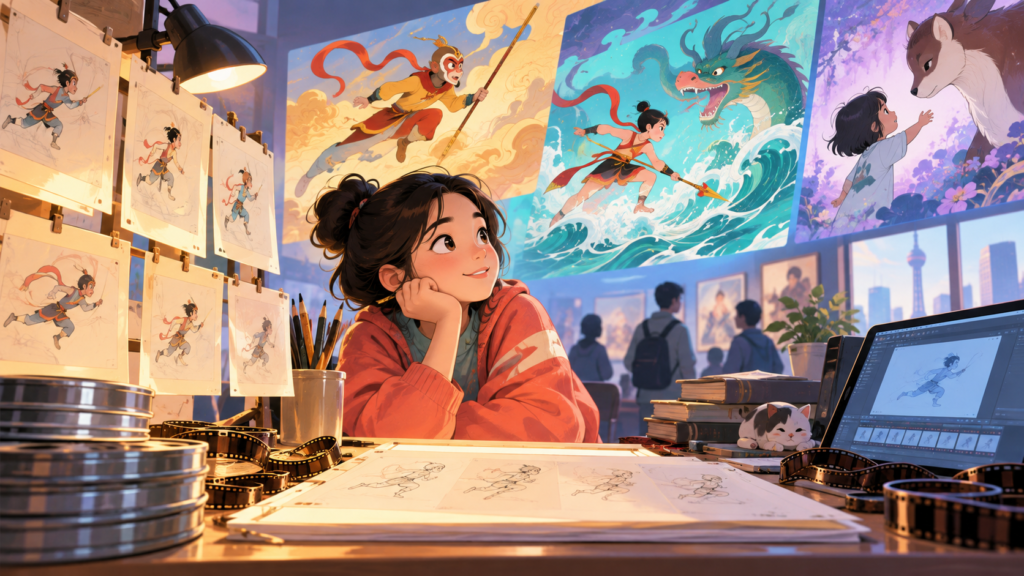
When you see a new animated film, it is easy to imagine a screen full of software. Shanghai’s animation history reaches back to work made with very different tools and techniques. A city report on a new animation space in 2026 recalled films including Uproar in Heaven, Nezha Conquers the Dragon King and Where Is Mama?
Those titles are a starting point, not a list you must memorise. Pick a short scene and ask how motion was created. How many decisions sit behind a character’s turn, a changing expression or a background that feels alive?
The tadpoles looking for their mother
Take one actual film from the studio’s history: Where Is Mama?, the 1960 ink-wash animation about tadpoles searching for their frog mother. It gives the question about movement a story to attach to. The little searchers have to encounter other creatures and make sense of who their mother might be; the pictures carry their uncertainty as well as their progress through the pond.
In his 2022 analysis for the Society for Animation Studies, animator Shengwei Zhou describes the tadpoles mistaking other creatures for their mother. He also explains a visual choice: empty areas of the picture suggest water, rather than every stretch of pond being painted blue. The creatures move through a space partly supplied by what has been left unpainted.
The analysis identifies a shrimp’s form as drawing on Qi Baishi’s painting. A few marks can make the creature recognisable while leaving its outline soft. That gives you something specific to follow if you watch the film: how much of an animal is defined, and how its movement makes sense within the open space around it.
The example is more useful than asking whether older animation had enough technology. The artists were solving a practical storytelling problem: how to make a painted-looking world move, and how to help an audience follow that movement. A pause, a change of direction and a sound can each do part of the work.
Making a movement readable
The Shanghai Animation Film Studio was established in 1957, according to the city report. Its history is part of the new venue’s exhibition, alongside contemporary reinterpretations of familiar characters. That brings earlier work into conversation with newer ways of presenting it.
The exhibition also included an XR experience connected with the Monkey King story. The history is therefore not being treated as something that can only be admired at a distance. New tools offer one way to return to an existing character, without making the original film disappear.
To understand the creative work, start with one small movement. A character turning towards a sound needs more than a change in position. The speed, the pause beforehand and the expression afterwards can all affect what the audience thinks the character has noticed.
You can explore that with drawings on separate pages. Keep the character roughly in the same place, change a detail a little at a time and compare the sequence. This is a beginner’s exercise in thinking through movement, not a reconstruction of the studio’s production methods.
Try making the movement quick in one version and hesitant in another. The basic action can remain the same while its meaning changes. A sudden turn might suggest surprise; a slower one could leave time for uncertainty. The result depends on the choices you actually make.
Backgrounds matter too. An audience needs to understand where a movement takes place and which part of the picture deserves attention. Adding detail everywhere can compete with the action rather than improve it.
That is why looking at an older animated scene is not only a hunt for technology that seems outdated. You can watch how the artists direct attention and make a moment readable. A contemporary production faces those questions too, even when its tools are very different.
The interesting comparison is between decisions, rather than a contest over whether hand work or software deserves more praise. Both require people to decide what should happen in the picture and what the audience needs to see.
Every frame is a choice
The films used distinct visual approaches, and it would be wrong to imagine one uniform style called “Chinese animation”. Artists looked to different stories, materials and traditions. The new space invites visitors to see that range rather than reducing the past to a single nostalgic picture.
The municipal account describes the venue and its history; it is not a substitute for watching the films. If you do watch one, notice something the technology does not explain: timing. A pause can be funny, frightening or gentle, whether the frame was made by hand or on a computer.
Try animating a paper character for ten seconds. You may never again watch a smooth turn without thinking about the patient person who made it possible.
Explore next
Sources
- Shanghai Municipal Government: New animation space opens in Shanghai
- Shengwei Zhou, Society for Animation Studies: The Aesthetic Features and Philosophy of Early Chinese Ink Painting Animation, 10 January 2022