
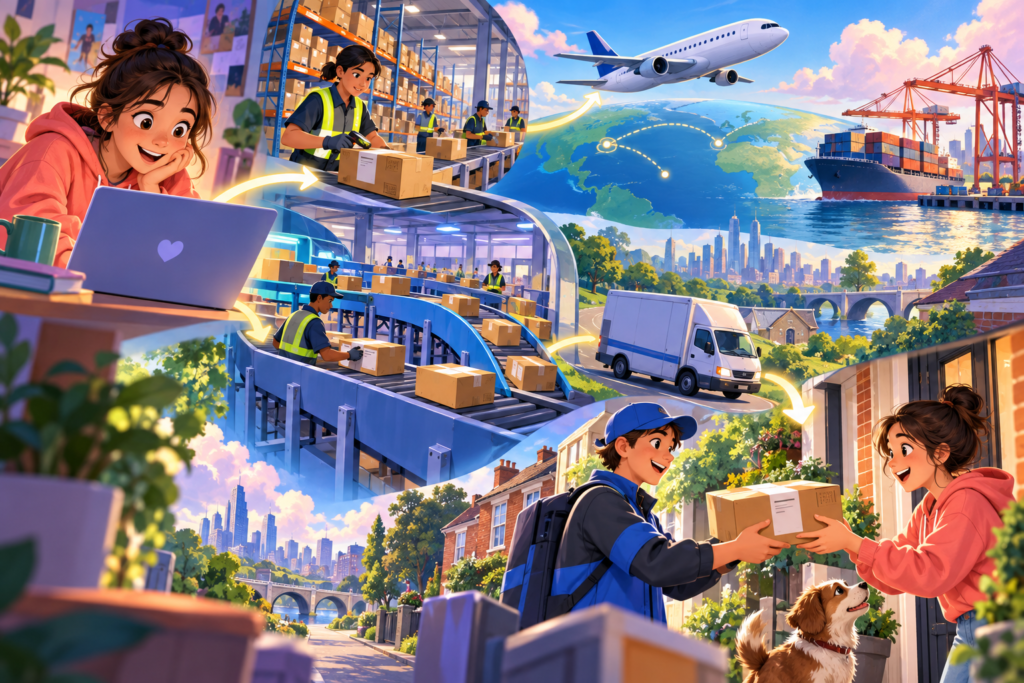
On a tracking screen, a parcel appears to move smoothly between a few dots. The box itself has a less tidy journey: it must be identified, sorted, loaded, handed over and finally connected with one recipient. A long-distance trip is only useful if the final local delivery works.
An April 2025 account from the Universal Postal Union gives a specific Chinese example. China Post and Cainiao have worked together on rural delivery, combining postal facilities with logistics systems. The UPU traces the partnership to a 2014 agreement between China Post and Alibaba, Cainiao’s parent company, followed by a China Post–Cainiao agreement in December 2020. One of its central problems sounds surprisingly ordinary: getting different networks to understand the label on the same box.
A label has two jobs
A delivery label describes where a parcel is going and gives it an identity within the system. Those are related, but they are not the same. Two boxes can have the same destination while containing different orders, arriving on different days or requiring separate delivery records.
The identity is what lets a tracking record refer to one object throughout its journey. When the parcel is scanned, the system can connect that event with the right record. The destination information then helps decide where the physical object should go next.
The UPU report describes electronic waybill recognition across the two organisations’ networks and sorting at county-level postal facilities. A waybill is the delivery record associated with a shipment. If another organisation takes over the box, recognising that information avoids treating the handover as a completely new, unidentified shipment.
This is a practical reason why logistics needs software as well as vehicles. A faster conveyor would not solve a system’s inability to interpret a label. Conversely, a perfect digital record cannot move a box that has been left in the wrong place. The information and the object must keep meeting each other.
The county sorting point is a junction
The UPU account describes linking distribution facilities with local delivery points. Sorting brings together parcels that have arrived through different routes and separates them for their next destinations. That junction is particularly important where the next stage is a spread-out rural network rather than a dense city street.
Think about a collection of addresses in different villages. Putting everything into one vehicle is not enough; the onward route needs to connect those addresses with places the delivery service can actually reach. The sorting decision is therefore connected with the local network, not merely with the parcel’s progress across a national map.
“Last-mile delivery” is the name for this final connection. It does not necessarily describe a literal distance of one mile. It identifies the part of the journey in which a broad distribution system has to reach an individual recipient. A parcel can have completed most of its distance and still have this essential work ahead.
Sending a parcel needs a return route into the network
The same cooperation also involves tools for people sending items. The UPU describes label printing and self-service shipment facilities. These help turn an item somebody wants to send into an object the wider system can identify and route.
At that starting point, the address and contact information have to become a usable delivery record. Printing puts part of the digital information onto the physical package. From then on, the visible label acts as a link between what somebody can hold and what the system knows about it.
That connection also explains why tracking updates are events rather than a continuous film of the box. A record can say the parcel was processed at a particular stage without showing every minute between stages. Looking at a map gives a simplified account of a chain of working handovers.
The important dot is the final one
Rural delivery cooperation is interesting because it starts with a real organisational problem. Different companies, facilities and local routes need to work together, and that requires shared information as well as a place to put the parcels.
It would be misleading to turn this one account into a promise about every delivery service in China. It describes a particular partnership and its reported arrangements. What it makes visible is the work behind a cheerful notification: somebody has to connect a label, a route and a recipient before “delivered” describes more than a word on your phone.
Explore next
Sources
- Universal Postal Union: China Post and Cainiao: rural last-mile delivery, 28 April 2025