
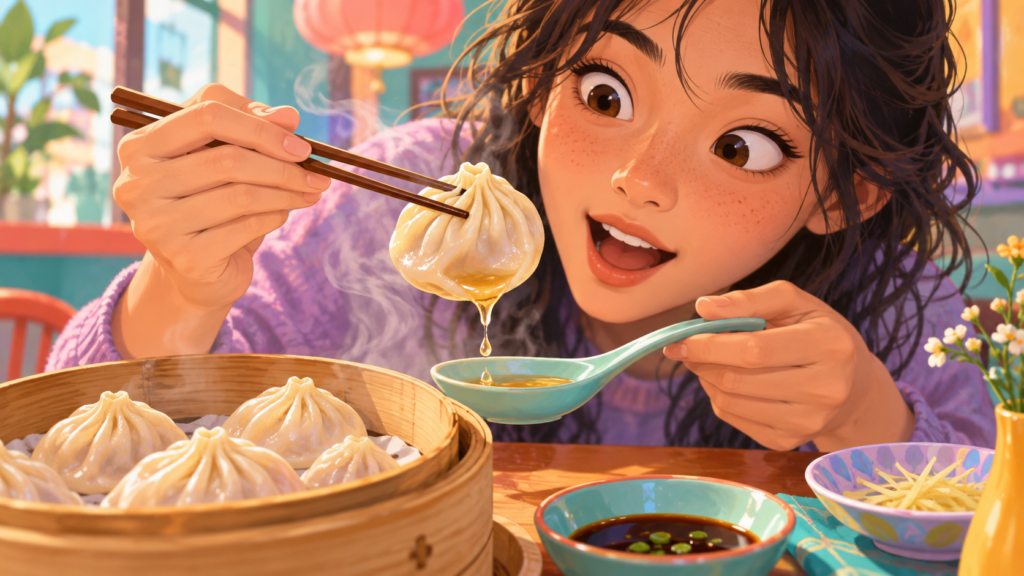
Imagine lifting a dumpling and discovering the soup has come with it. That is the attraction of xiaolongbao, small steamed parcels often filled with meat and hot broth. It is also a warning to slow down: biting straight through a freshly steamed one can send hot liquid where you did not want it.
Shanghai’s food guide suggests making a little opening, letting steam escape and tasting the broth before eating the rest. Vinegar and ginger are optional companions for many diners. The exact filling can change with season and shop.
A careful first bite
There is a small ritual in holding the dumpling without tearing it. The wrapper must contain the broth until you choose to open it. A photograph can show the folds on top, but it cannot show the moment someone learns not to rush.
The guide connects a famous Shanghai style with Nanxiang and mentions different local sellers. It also gives a much longer historical background, some of which is difficult to compress into a tidy origin sentence. Better to say that the modern dish belongs to a wider history of filled steamed foods than to claim one person invented every version.
How does the soup get inside?
The city guide explains that meat jelly is added to the filling. During steaming, it melts into liquid. That gives the maker a way to enclose the filling before it becomes the hot broth the diner finds inside. The soup is not necessarily poured into an already sealed dumpling.
The wrapper therefore has two jobs at different moments. It has to be folded around the filling while the parcel is being made, then hold the liquid after steaming. A thin wrapper is part of the attraction, but it still needs to remain intact long enough to reach the spoon.
The folds at the top belong to that practical task as well as the appearance. A neat-looking dumpling may invite a photograph, yet its usefulness becomes clearer when you think about what it has to contain. This is a dish where making a small object and eating it are closely connected.
The guide lists pork and crab-related fillings, along with seasonal vegetable variations. Those choices show why knowing the name xiaolongbao isn’t the same as knowing every ingredient. A restaurant or cook can explain which version you have in front of you.
The spoon matters too. It gives the dumpling somewhere to rest and can catch liquid when the wrapper is opened. There is less reason to rush if you have a place for both the parcel and its broth. Letting steam escape is part of taking care with hot food, rather than a test of elegant table manners.
It is possible to become so interested in the eating technique that you forget the making. Someone had to balance a wrapper, a filling and the change that happens in the steamer before the dumpling arrived.
Once you understand that change, the soup inside feels less like a trick and more like a clever use of ingredients. The little parcel has been designed to become something different when heated.
Two soup-parcel cousins
There are other foods that hide hot liquid inside dough. Pan-fried shengjian has a different outside and cooking method. The family resemblance makes the differences more interesting.
If you try xiaolongbao, the best lesson may be patience. The first bite is not a race to prove you know what you are doing. Give the steam a moment to leave, and the soup will still be there.
Compare the different dumplings in these two stories: A fried bun with a surprise inside and What would you put in a wonton?.
Sources
- Shanghai Municipal Government: Xiaolongbao: A small dumpling with a big story