
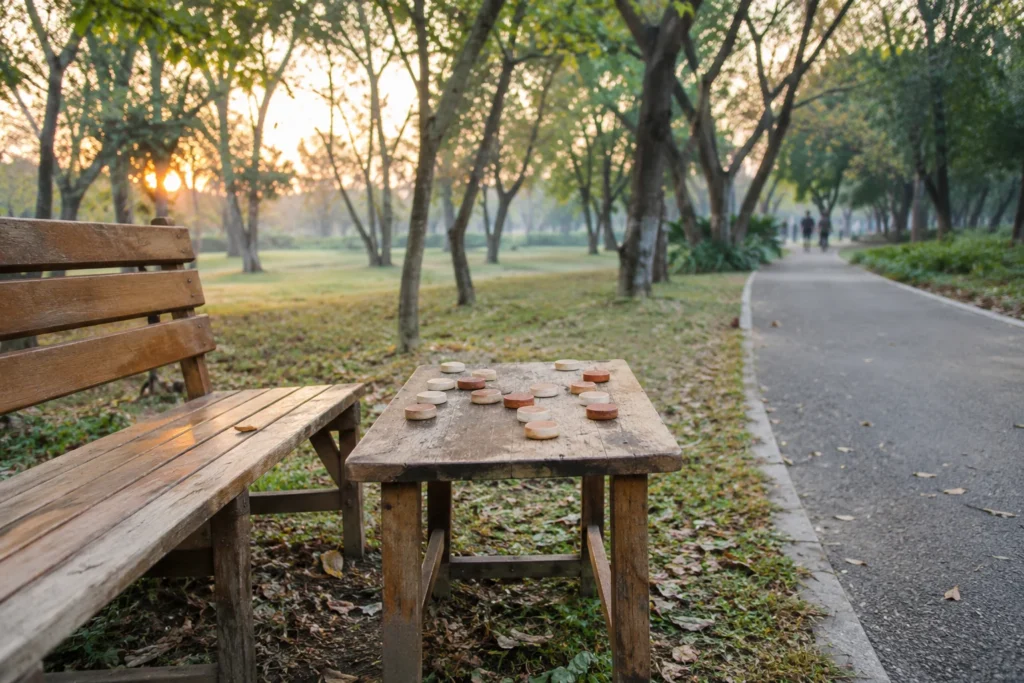
An urban park can be a place to exercise, play games, make music and meet people—not just somewhere to sit quietly. Research on older users in Nanjing’s parks examines how facilities such as shelters and pavilions support those activities. The design matters because different visitors need different ways to use the same space.
A place to stop matters as much as a path
A study published in 2020 examined older visitors in ten Nanjing parks. Its attention included amenity buildings such as shelters and pavilions: structures that give people somewhere to pause or gather within the landscape. (Compare a park designed for cycling.)
The researchers combined observation with questionnaires. Those methods ask different questions. Watching records what people do in a place, while asking them can add information about their use and experience. Neither is a complete picture on its own.
The study found relationships between the environment around these structures and social activity. It considered factors including scale, lighting and nearby amenities. The finding concerns the studied settings; it is not proof that adding any pavilion to any park guarantees better health.
It does make the apparently modest building worth noticing. A path helps someone move through the park, while a seat or shelter can make stopping possible. Social use needs opportunities to remain somewhere as well as routes for arriving.
Think about an imaginary group wanting to meet outside. They might need somewhere to sit, a location that is easy to find and room to stay without blocking a path. The design problem is more specific than simply providing a large area coloured green on a map.
Different users can need different arrangements. A quiet bench and an open space for activity both have purposes, but they are not interchangeable. A useful park can provide several kinds of setting without assuming every visitor wants the same afternoon.
A public room without walls
The same path can be an exercise route early in the morning and a place for children later. A patch of open ground can support different groups at different hours. That makes a park more like a shared room than a green photograph.
It is easy to turn people in a park into a picturesque travel clip. Better to ask what helps them gather: access, safe paths, shade, seating and enough room. Think of your own local park. Who gets to feel that it belongs to them, and who might still find it hard to use?
Explore next
- How would you explore a city by bike?
- Who lives on a mountain above the clouds?
- What would you eat at a Beijing night market?
Sources
- pmc.ncbi.nlm.nih.gov: Research on urban parks and older adults in China