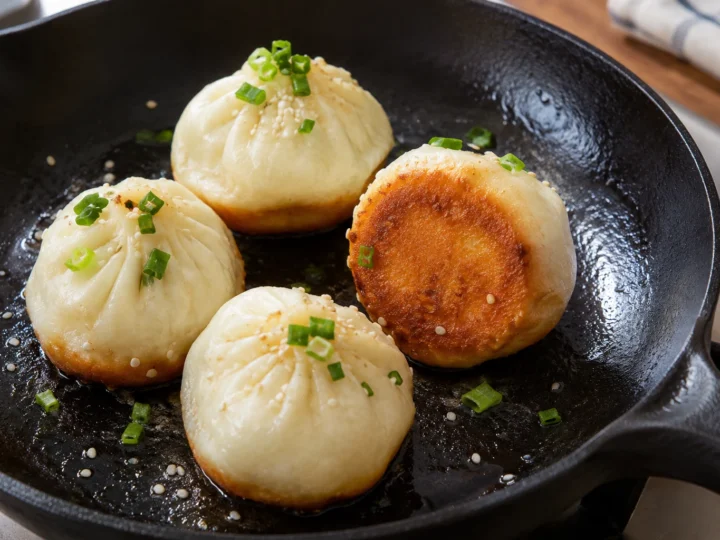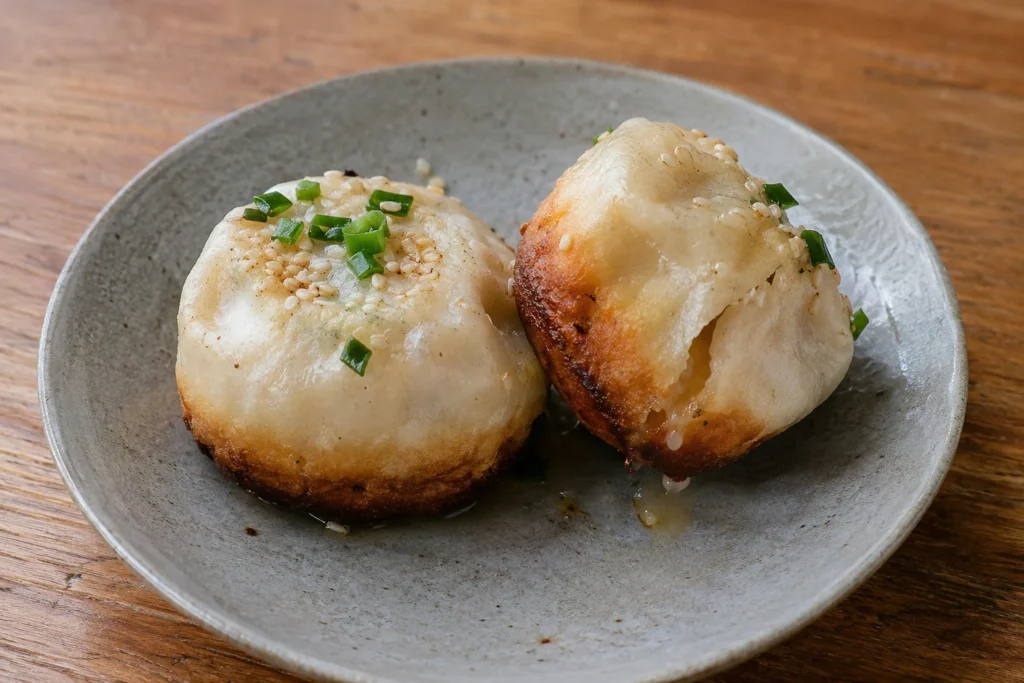
Shanghai pan-fried buns can combine a crisp base, cooked dough and hot juices because frying and covered steaming happen in the same pan. The city’s guide distinguishes an aspic-filled style from a fully leavened style relying on meat juices. The soup inside therefore has more than one possible explanation.
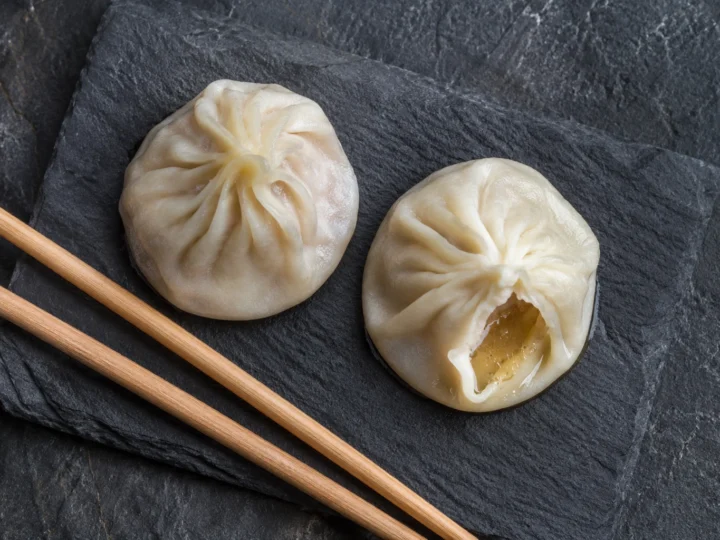
In one style of Shanghai shengjian, the liquid begins as aspic: concentrated stock that has set before cooking. It can be enclosed with the pork filling while it is solid. As the bun cooks, the aspic melts, leaving broth held inside the dough. There is no need for a cook to inject each finished bun with a tiny funnel. (Compare steamed soup dumplings.)
The bottom and top have different jobs
It is rather like looking at a cross-section instead of treating the whole bun as one uniform object. The outer dough holds a filling, the bottom meets the pan, and the contents change as they heat. Each part helps explain what you may find when you open it.
You don’t need to reproduce the recipe to understand that relationship. Following a proper recipe would require much more than the broad description here, including knowing how to cook the filling safely. As a food story, though, it gives the hot liquid an explanation.
Plenty of broth isn’t the only answer
Shanghai’s April 2026 guide distinguishes two broad styles. One uses added aspic and partially leavened dough. Another uses fully leavened dough, with a more bread-like texture, and relies on juices from the meat rather than added aspic.
So “pan-fried bun” doesn’t promise the same amount of broth every time. A version with less liquid hasn’t automatically gone wrong; it may follow a different approach. Once you know that, a debate about which bun is best starts sounding more like a discussion of preferences.
The guide describes those differences through particular Shanghai businesses. It gives examples rather than a rule requiring every shop to make an identical bun. A name can connect foods while leaving plenty of room for the people making them.
There is also a history beyond a single city’s boundary. The same guide traces the snack to nearby Suzhou in the early twentieth century and then to Shanghai. That is its account of the food’s movement, rather than a claim that we have settled every question about the first bun.
Shanghai’s earlier guide also describes a finish of chopped scallion and sesame seeds. What you notice on top is another part of the preparation, rather than a way to identify the exact filling.
Give the first bite a moment
The city guide suggests opening a bun carefully and dealing with its broth before eating the rest. The useful point is that the filling may be very hot. A crisp base isn’t a reliable clue to the temperature inside.
You can let it cool and ask what kind you have been served without turning lunch into a speed test. If ingredients matter to you, check that particular product too; a broad account of a pork-bun style can’t replace a shop’s information.
The first surprise may be soup. The more interesting discovery is the work that allowed soup, soft dough and a crisp bottom to share such a small space. What looked like a simple snack turns out to have several things happening at once.
Explore next
Sources
- Shanghai Municipal Government: Pan-fried pork buns
- Shanghai Municipal Government: Pan-Fried Buns