
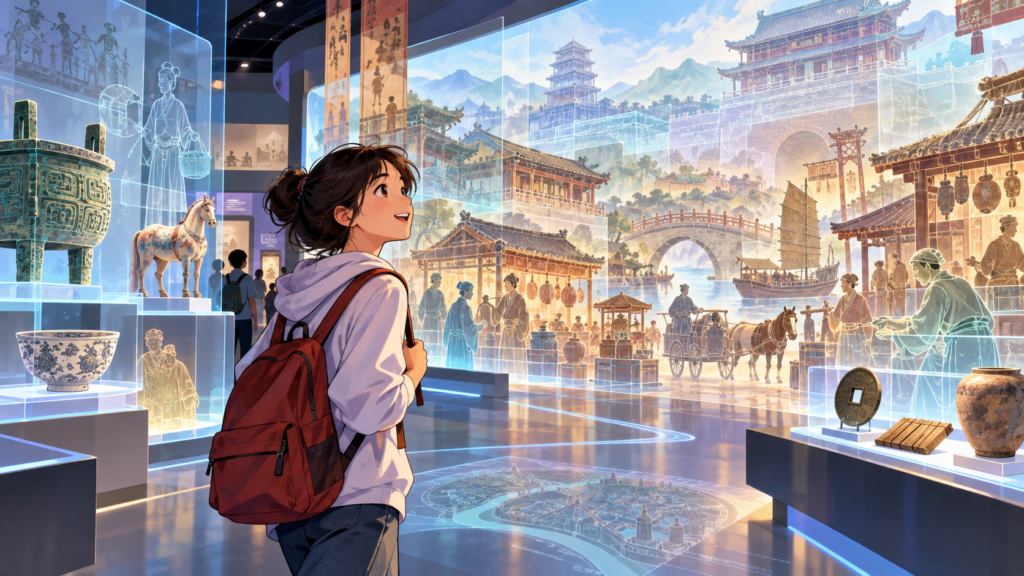
Imagine arriving at a dinner where the tableware is more than 2,000 years old, your host is a Han noblewoman and someone has stolen a treasure. You can help decide what happens next. That sounds like a game pitch, but there is a real museum experience behind it: Lady Xin Zhui’s Dinner at Hunan Museum in Changsha, Hunan.
The exhibition launched in May 2026. Visitors sit in specially arranged seats and put on VR equipment, rather than walking freely around an ancient city. That distinction matters: the experience brings a reconstructed household into your field of view while you remain seated in the museum.
You arrive with a part to play
You take the role of Li Xi, Xin Zhui’s son, in a story built around a stolen treasure. The museum’s launch information describes three routes through the adventure: military strategy, martial arts, and ritual and music. It advertises more than 100 smaller narrative branches, with choices and task performance affecting the outcome.
Those branches are a game structure, not 100 newly discovered historical events. Choosing a different response changes your version of the experience. It does not change the archaeological record. Keeping that difference in mind makes the game more interesting: you can enjoy the invented problem while asking which parts of its surroundings have evidence behind them.
Xinhua’s report, illustrated with photographs taken at the museum in May, confirms that this was an operating exhibition rather than just an announcement. It describes live performances combined with reconstructed scenery and the same three routes through the story. There is something satisfying about finding out what visitors actually do, beyond a promise that history will be “immersive”.
The dinner has an archaeological pantry
Mawangdui is the excavation behind the exhibition. Three tombs associated with Li Cang’s family were excavated in Changsha between 1972 and 1974. The Hunan government’s account of its digital heritage project describes more than 3,000 objects from those excavations. Together they provide evidence about an elite household’s possessions and the early Han world.
That does not make the dinner a photograph of one evening. Objects found in a tomb and a scene showing those objects being used are different things. A reconstruction has to make decisions about where people sit, what they do and how the objects fit into a room. The interest lies in making those decisions answerable to the surviving material.
Xinhua describes diners kneeling at lacquer tables, with individually served food. The virtual meal includes roasted meat, soup and rice, connected in its report with foods recorded on excavated bamboo documents. This is a much more precise starting point than putting a vaguely “ancient-looking” banquet behind a headset. Food, furniture and written records can be considered together.
The display also gives visitors a way to examine digital objects through hand gestures. Turning a model to see its surface is different from looking at a single photograph, although it still cannot replace the original material. A digital lacquer vessel has no physical weight in your hand; the real object remains in the museum’s care.
How the people and objects reach the headset
The launch account describes scanning Mawangdui artefacts to make detailed three-dimensional reconstructions at their original scale. Its underlying resources come from the Shanhai digital platform, with museum specialists involved in checking the exhibition’s archaeological content. The scanned objects supply an important connection between the gallery and the virtual room.
For the filmed material, the makers used two fisheye lenses to capture a 180-degree stereoscopic view. “Stereoscopic” means that the two eyes receive slightly different views, helping the scene appear to have depth. Filmed performers can then be combined with a computer-generated setting. The technical description includes separating them from their filmed background and rendering the combined scene in a virtual engine.
That combination explains why the experience need not look like either an ordinary film or a completely animated game. Recorded acting can supply the people; digital modelling can supply objects and spaces that no longer survive as a furnished household. The two kinds of material do different jobs within the same view.
You can explore a reconstruction without believing every scene
UNESCO’s older Changsha profile mentions a separate initiative called Time Travel to Han Dynasty. It establishes the city’s earlier interest in VR and heritage, but it is not evidence that the later museum dinner is that same project. Nor should Changsha be confused with Changzhou: they are different cities.
The most useful question to take into this kind of exhibition is simple: what supports the thing I am looking at? A vessel might be based on a scanned find, a dish on a written record, and the theft on the needs of the game. Each can belong in an engaging experience, provided their different roles remain understandable.
Lady Xin Zhui’s Dinner offers a particular route into the past: seated VR, an interactive plot and a household assembled from archaeological evidence. Its strongest invitation is to return from the virtual table to the real objects and notice details you might otherwise have walked past.
Explore next
Sources
- Hunan Department of Culture and Tourism: Lady Xin Zhui’s Dinner: launch and technology, 30 April 2026
- Xinhua: A visit to Lady Xin Zhui’s Dinner, 18 May 2026
- Hunan Provincial Government: Mawangdui digital resources, 9 January 2024
- UNESCO: Changsha Creative City profile