
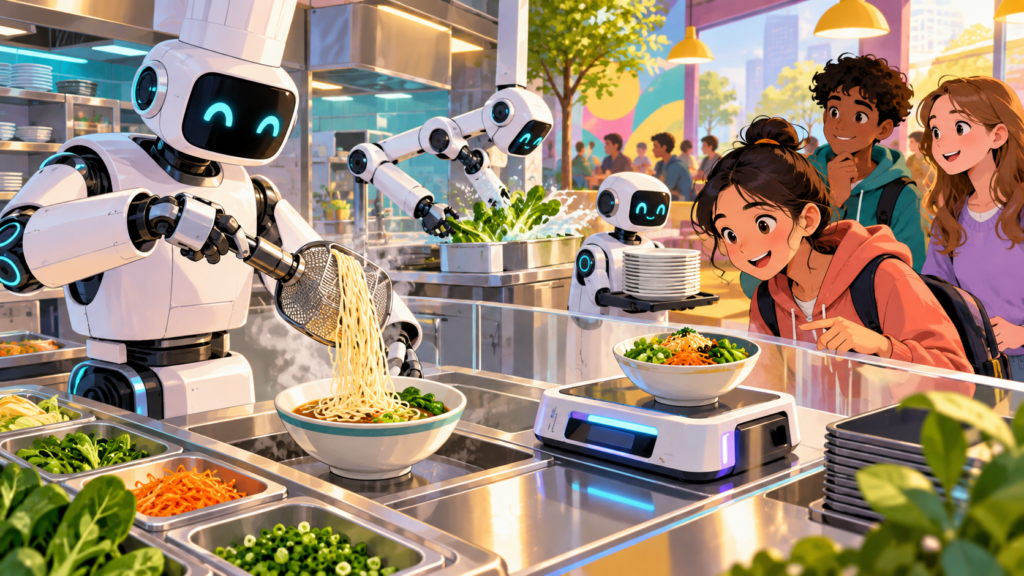
At a Beijing experimental canteen, robots have been described washing vegetables, making noodles, cooking and clearing up. A clever plate can even help weigh food and show a price. It sounds like the kitchen of a cartoon set a few years from now, but the Haidian Dining Hall was open by 2026.
The Beijing city portal describes a working restaurant, not a laboratory behind glass. That makes it a useful place to ask whether automation improves a real meal rather than simply looking impressive in a demonstration.
Your plate joins the system
The restaurant has a precise address, rather than being an unnamed glimpse of the future: the second floor of Building 1 at the China Agricultural University International Entrepreneurship Park, on Tianxiu Road in Beijing. The city’s report was published in May 2026 and dates its opening to 22 December the previous year. This was an operating experimental dining hall when the report was written.
At the serving counter, a diner puts food on a plate containing a chip. Weighing connects the quantity chosen to the price displayed. The screen also presents estimated calories and protein, and the report describes nutrition information being available through a mini-program. Those figures are information supplied by the restaurant’s system, rather than an individual medical assessment.
There is a different calculation at the noodle station. The city account describes a machine able to prepare four bowls, with different flavours, in four minutes. That is a reported capability, not a promise about every customer’s waiting time. Choosing thickness or texture changes the order the equipment has to fulfil.
These details make the experiment easier to understand. Automation touches both the kitchen and the diner’s decisions. The meal still needs people to organise the ingredients, operate the equipment and keep service moving; the robot arm is only the part that makes an especially good video.
The parts you cannot see
The plate-by-weight system might help someone choose a smaller portion. It also raises questions about the information shown on the screen: how accurate are nutrition estimates for mixed dishes, and what happens to data from the checkout system? Those are questions for the operators, not conclusions to invent.
The people haven’t left the kitchen
The city’s account actually names a human team: one chef and two operators working alongside the equipment. That detail changes the picture more than another photograph of a robot arm. The canteen is a collaboration of people and machines, even when a machine does a conspicuous part of the work.
The noodle station makes the chain particularly clear. The report describes kneading and rolling dough, followed by cooking and draining. These are separate stages, with the next depending on the previous one producing something usable.
A restaurant isn’t simply a collection of impressive movements. If dough is prepared but the rest of the meal isn’t ready, the diner is still waiting. The interest lies in how the stages fit together across a lunch service.
At the counter, the customer contributes another decision. The weighing system lets diners choose food and then see a calculated price. It differs from buying a single fixed portion because the quantity selected becomes part of the transaction.
The chip in the plate connects that physical choice to information on a screen. The portal says nutritional information can also be sent through a mini-program. Seeing a number, however, leaves questions about how it was calculated and how a mixed dish is represented.
Those would be fair questions in any canteen offering such figures. The robot doesn’t make them irrelevant, and the fact that a screen displays them doesn’t answer them. It is possible to be interested in the technology while still wanting an understandable explanation.
The most useful comparison is with the job the restaurant is doing. Preparing ingredients, coordinating a service, helping a diner and clearing up all count. A noodle-making machine may be the feature people film, but the less photogenic links decide whether the meal works as a whole.
Would you return for dinner?
Judge the canteen as a diner first. Is the food tasty and safe? Can staff help if the machine misunderstands? Does the meal feel affordable? A robot that makes perfect noodles once is less useful than a restaurant people actually want to return to.
The story is not that Beijing has become a city of robot kitchens. One experimental canteen lets us see a possibility and test it against ordinary expectations. Dinner is a good place for that test because everybody knows when dinner is disappointing.
Explore next
Sources
- Beijing Municipal Government: This Futuristic Robot Canteen Is Now Open to Everyone