
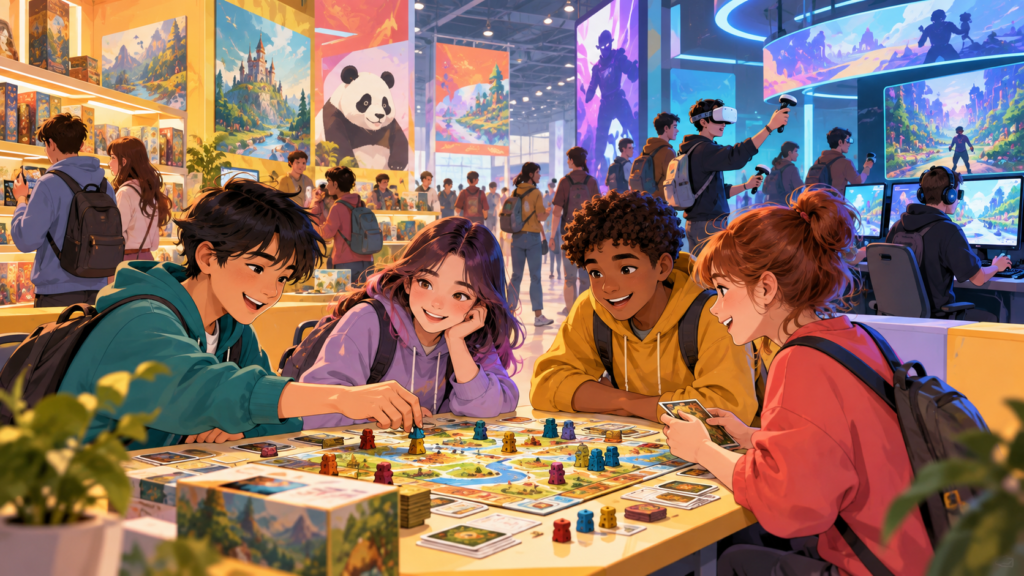
At a game expo, you might expect headphones, enormous monitors and somebody explaining a new controller. In the published programme for Shanghai’s 2026 China International Cartoon and Game Expo, tabletop games had their own space too. Sometimes the most interesting piece of equipment is a table.
The official July preview described independent designers alongside established publishers. Another city listing included public tables for walk-in sessions, an area for tabletop role-playing and a student game showcase. These were plans for the July 2026 event, rather than proof that every promised activity happened exactly as advertised.
Even as a programme, it offers a useful reminder: gaming includes several ways to take part, and trying a new game needn’t begin by picking up a controller.
The best demo needs another player
A board game can be difficult to judge from its box. You might like the artwork without understanding the choices you will make, or read the rules without knowing how it feels when someone else takes an unexpected turn. Sitting down together lets the design become an experience.
Imagine a game where players must decide whether to cooperate or hold something back. A poster could list that rule, but another player’s decision is what makes your own choice interesting. The same starting position might become very different when a friend joins the table.
That is one reason a public session can be valuable. A person who has never heard of a title can ask how it works, try a few turns and discover whether they enjoy it. The explanation and the response happen in the same place, rather than being separated by a purchase.
It can also help a designer hear where the rules aren’t clear. Suppose a new player misunderstands an instruction. The designer may discover that a sentence which seemed obvious on the page needs another example. Watching someone learn is different from watching an experienced group play smoothly.
Those are possible benefits of a demonstration table, not a report of conversations we witnessed at this expo. The programme tells us that organisers made room for trying games; it can’t supply every player’s experience.
A world made around a table
Tabletop role-playing adds another kind of participation. Much of what players respond to is described in conversation, with their choices helping a shared story develop. A scene can matter even when there is no large screen displaying it.
Imagine being told that a door is locked and deciding with the others how to approach it. One player might suggest asking for help; another might look for a different route. The appeal is partly in hearing what people do with the situation, rather than simply seeing how it has been drawn.
That doesn’t make tabletop games more authentic than video games. It helps explain why several forms can belong at an event devoted to games and animation. They give players different things to notice and different ways to contribute.
A student showcase belongs in that picture as well. A game is something people make, not only something people buy. Seeing an early project could make the process easier to imagine: choosing rules, explaining them, trying them with others and finding out what needs changing.
More than one kind of gaming
The Shanghai listings placed the expo within a wider summer programme that also named BilibiliWorld and ChinaJoy. A city promotion isn’t an independent ranking of the best games or events, but its range of planned activities is still worth noticing.
Fans, students, small designers and large publishers can be interested in games for different reasons. A table can give some of them a shared starting point: here are the pieces, here is what we can try, and here is somebody ready to play.
Next time someone talks about gaming as though it means only watching a screen, picture that table. The important part of the demonstration might be the moment another person sits down opposite you.
These two board-game stories look at a river on a board and a travelling game: Why is there a river on the board? and Could a chessboard be a travel object?.
Sources
- Shanghai Municipal Government: China International Cartoon and Game Expo to kick off in Shanghai
- Shanghai Municipal Government: Game on: Shanghai’s summer of animation and gaming begins