
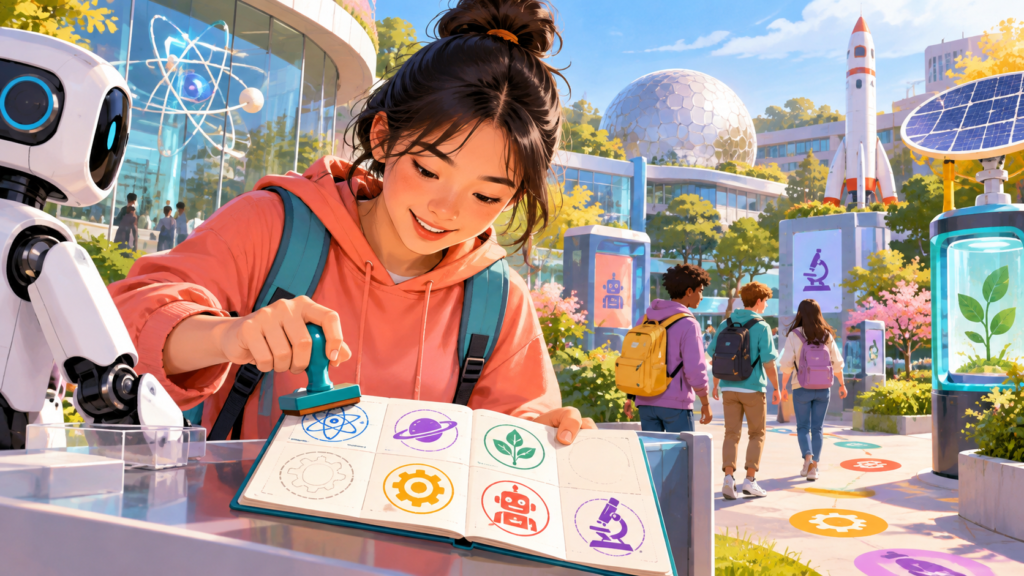
Stamps can make almost any trip feel like a quest. An August 2026 announcement described a programme of routes through ten science and technology parks in Beijing’s Haidian district. Visitors could complete activities, collect stamps and, under the scheme’s rules, receive a souvenir.
The stops focused on subjects including robotics, manufacturing, aerospace and agriculture. Usually those words belong in a serious report. Put them on a map and a person can ask, “Which one would I actually want to see?”
A trail into someone else’s work
A technology park is not normally a place where a casual visitor expects to wander in. A planned route can make some of its work easier to see. That does not mean a one-day activity explains how a robot or satellite is built. It may only give you a first question worth taking home.
Beijing’s programme linked three routes, each with a different set of stops. That is more interesting than a single giant “future” exhibition where every machine looks exciting but the differences blur together. A visitor interested in food might choose the agricultural stop; another might head for spacecraft.
A robot drink is only the first question
The August announcement gives a few concrete examples of the activities. At one stop, it described a robot-run beverage station; elsewhere, it listed small transport products such as self-balancing and electric scooters. These examples put an ordinary task beside the technology used to carry it out.
That makes a useful starting point for curiosity. Watching something serve a drink could lead you to ask how the order reaches it, which part of the job it performs and what a person still has to do. Those questions go further than deciding whether the machine looks futuristic.
A demonstration can make an idea visible, but it doesn’t establish everything about how the product works elsewhere. We shouldn’t infer accuracy, reliability or everyday usefulness from an announcement that says visitors can try it. A trial is one encounter with a system, not a complete evaluation.
The three routes also group different interests. The southern route included aerospace and AI, the central route manufacturing, and the northern route robotics and biological agriculture among its subjects. You could choose the theme that gives you the best questions, rather than feel obliged to collect every possible stop.
The stamps provide a record of visiting. They don’t need to become an exam score for understanding the whole site. Someone who stops at one place and leaves with a precise question may have found something more useful than a completed collection they rushed through.
The souvenir scheme had its own conditions, including a reservation process and a requirement linked to sharing trip photos. Those conditions belonged to the published summer programme. They shouldn’t be read as a promise that the same rewards or access remain available now.
What lasts beyond the scheme is the idea of making real work approachable. A small task or demonstration can give a visitor a way to begin asking about something that had previously been only a large technical word.
What would earn your stamp?
A good checkpoint could ask visitors to do something small: test a sensor, compare designs or work out what a machine is solving. A photograph alone is a thin reward. The official description mentions interactive activities, but it does not prove every stop offered the same kind of access.
The 2026 trail had dates and rules that should be checked again before a visit. As a story idea, though, it works even when the stamps are gone: curiosity can start with choosing a route through real work, not just watching a shiny video about “the future”.
Two other learning stories follow a robot challenge and a classroom in space: Could you build a robot for a teenage challenge? and What would you ask an astronaut in class?.
Sources
- Beijing Municipal Government: Beijing Launches Three Tour Routes Covering Ten Sci-Tech Parks