
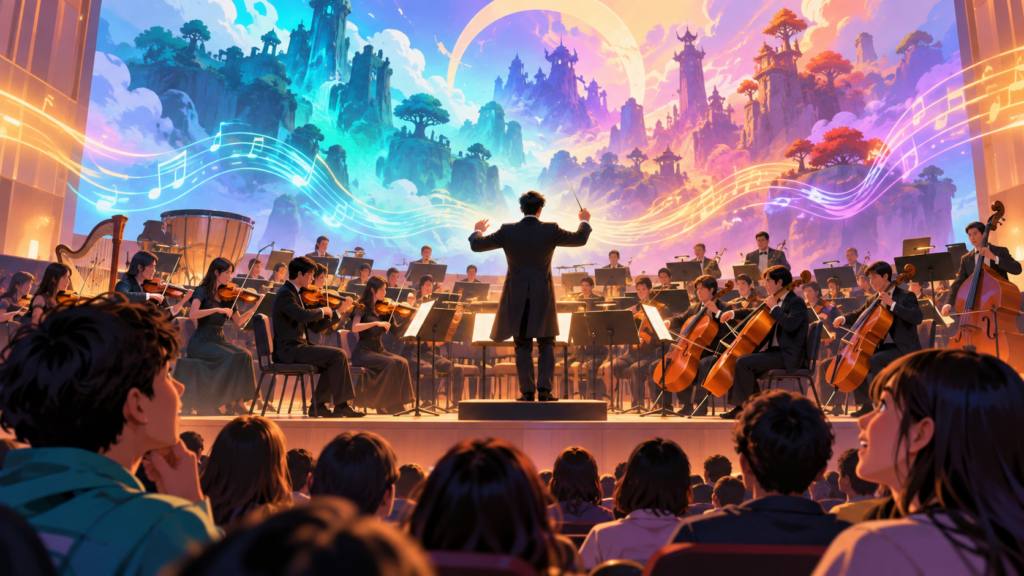
Picture an orchestra tuning up, then playing music you recognise from a game. There is no boss battle on a screen and nobody is asking you to press a button. You just listen. Shanghai’s summer programme announced a July 2026 concert devoted to Dota 2, to be performed by the Shanghai Symphony Orchestra ahead of the game’s planned world championship in the city.
There is a small surprise in that arrangement. Game music is often doing a job while you are busy with something else: making a place feel huge, warning that danger is close or giving a victory its own sound. In a concert hall, the music has to stand on its own.
The soundtrack steps forward
Shanghai’s summer gaming programme called the event Chapters of Immortality and described it as the first dedicated Dota 2 orchestral concert. The programme also listed concerts connected with Wuthering Waves and other screen stories that year. Those are particular 2026 events, not evidence that every game has an orchestra following it around.
You do not have to play Dota 2 to understand why fans might want to hear the music live. Think of a film score: you can recognise a theme before you remember the exact scene. Games add a further layer because your choices affect when the music reaches you.
Listen without holding the controller
Imagine a piece you associate with reaching a difficult part of a game. During play, you may be concentrating on the next move and notice only that the music has changed. Listening separately could let you hear a quiet line or a repeated pattern you missed while trying to win.
The connection can work the other way as well. A familiar melody may bring a scene back even when there is no screen in front of you. The listener supplies a memory that another person in the room may not share. That difference can make a conversation afterwards interesting: what did the music suggest to each of you?
A concert arrangement also has decisions of its own. Music that works alongside a player’s actions has to be presented as something an audience can follow from beginning to end. Which passages to select and how to connect them are questions for the people preparing that performance.
We shouldn’t pretend to know the answers for this concert merely from its title in a programme. The city listing tells us the idea, the planned performers and the date; it doesn’t describe every musical choice or prove how the audience responded.
You can still try the listening experiment yourself with music you already have access to. Put aside the game for a moment and pay attention to what enters first, what changes and what returns. You aren’t required to name the instruments correctly to notice those differences.
If you later return to the game, see whether recognising the music changes what you hear. A sound that had seemed like background may become part of how you understand a place or a moment.
That isn’t an argument that games need an orchestra to become worthwhile. It is a way to appreciate work that was already part of them, by giving it a turn at the front of your attention.
Do you need to know the game?
Perhaps knowing every character makes a concert richer. Perhaps not knowing them lets you hear details that players miss when they are concentrating on a match. Both audiences can sit in the same room. That is a better test of a soundtrack than whether somebody calls gaming “real culture”.
If you have ever turned down a game’s sound and then wondered why it suddenly felt flat, an orchestra may explain it. The music was carrying more of the story than you realised.
For different stories about a musical performance and a familiar tune, continue here: How do school musicians get to Paris? and Can a tune remember a place far from home?.
Sources
- Shanghai Municipal Government: Game on: Shanghai’s summer of animation and gaming begins