
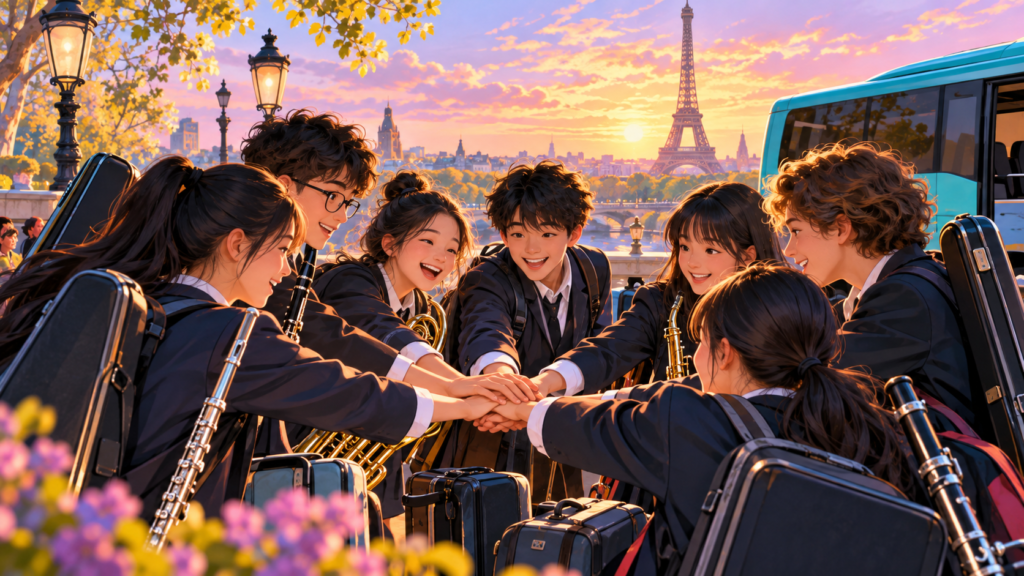
The exciting bit of a school orchestra tour is easy to picture: a concert hall, a new city and the last note ringing out. The less visible part is everybody learning to begin together after weeks of practice, travel and nerves.
In 2026, the Luming Wind Orchestra from Songjiang Minle School performed in the Netherlands, Belgium and France. Shanghai’s city account says 35 students joined the European tour, most of them still in primary school, and the group received a gold award at a festival in Paris.
Thirty-five parts of one group
The travelling group was smaller than the school’s wider orchestra, which the city account described as having more than a hundred members and two ensembles. That distinction matters: the tour represented a particular group of students, not everyone in the school’s music programme.
The report places the orchestra’s establishment in 2008. A performance abroad was therefore one chapter in an ongoing school activity, rather than a group assembled only for an award photograph. The setting gives the concert a history beyond that single day.
For a wind orchestra, the sound belongs to several parts working together. Imagine one player practising a passage alone and then hearing it within the full group. A phrase that seemed complete by itself may turn out to be an answer to something happening elsewhere.
That makes listening an active part of playing. You need to know your own notes, but also how they fit the pace and balance around them. It is possible to play the right passage and still need to adjust its place in the shared sound.
Travel adds another setting without changing that basic relationship. A new venue may make the occasion exciting, yet the music still depends on players responding to one another. The report does not describe every rehearsal or practical arrangement, so the unseen work should not be turned into an invented backstage story.
It does record exchanges with student music groups from other countries. Those meetings offer something different from the award: another chance to hear how people approach the activity you share. A conversation about an instrument or a difficult entrance has a concrete starting point.
The Paris result is worth celebrating on its own terms. It need not become a ranking of every school band, or a claim that music is only worthwhile when it travels abroad. The same act of listening closely can matter in a rehearsal room that never appears in a festival programme.
The piece you do not hear alone
An orchestra is a good reminder that being talented does not mean playing louder than everybody else. A clarinet line may matter because it leaves room for a flute. A percussionist might spend a long stretch waiting for one entrance and still change the whole piece.
The article quotes a young musician on the pleasure of meeting players from other countries through music. It does not tell us exactly what every student felt. Some may have been thrilled, others exhausted or nervous. Those ordinary feelings belong in the picture too.
The award is a fact about one tour, not a rule that all good music must win a prize. If your school has a band, choir or even a group rehearsing in someone’s bedroom, you already know the harder achievement: persuading different people to keep listening to one another until the sound holds together.
Music also connects these stories about exchanging a song and singing together: Can a song help you make a friend? and How Dong singers meet without a conductor.
Sources
- Shanghai Municipal Government: Songjiang school wind orchestra wins international gold award in Paris