
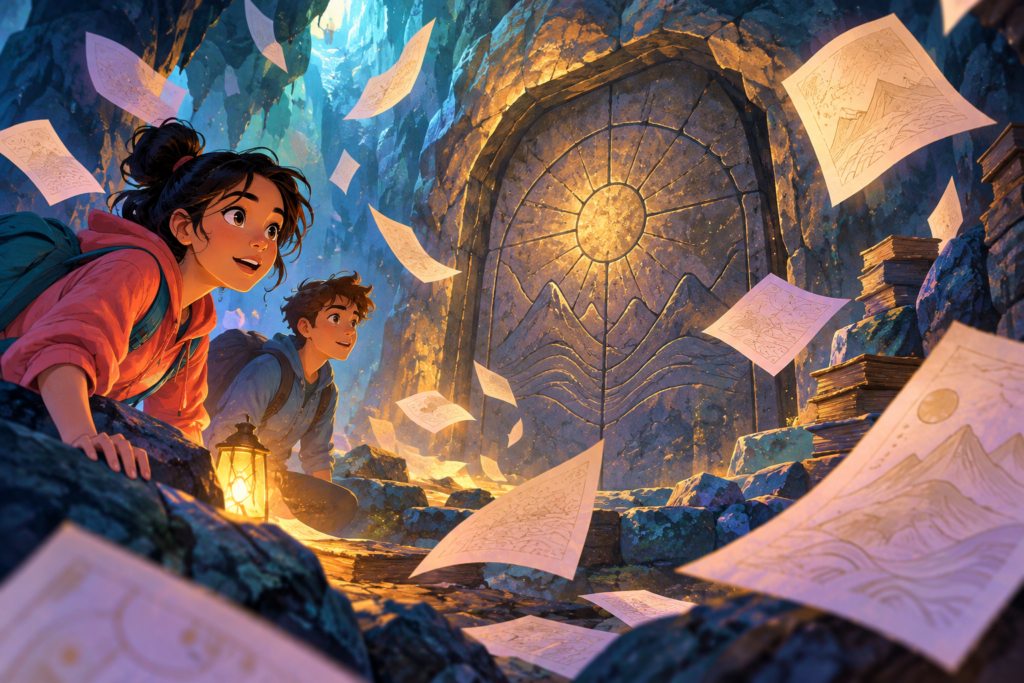
Imagine opening a small room and finding tens of thousands of manuscripts and pictures. Cave 17 at the Mogao Caves, often called the Library Cave, was reopened in 1900 by Wang Yuanlu. The material there was not one neat library of a single language or subject; it included religious texts and records of a connected world.
The International Dunhuang Programme describes Wang finding a sealed doorway leading to the chamber. The surviving objects open many routes into the past, but no collection can answer every question about the people who made and used it.
A book with two reading directions
One of the objects described by the International Dunhuang Programme is a Chinese-Tibetan concertina manuscript. Its pages fold back and forth rather than forming a familiar bound book. The languages are arranged differently, so reading the two scripts involves changing the manuscript’s orientation.
The object makes cultural contact visible in a very practical way. There is no need to imagine a conversation between its makers to notice the layout. The form itself gives the reader something concrete to examine: how writing in different directions shares the same material.
That is also a reminder that “manuscript” is a broad word. A folded book, a scroll and a loose leaf offer different ways to arrange and handle text. A digital image of one page can preserve its writing while making the larger shape harder to understand.
Another example, the Old Tibetan Annals, survives in two manuscripts from the same original scroll, now in separate collections. Here the relationship between pieces matters as much as any one piece. Knowing that connection changes how researchers can read the surviving record.
The cave’s later history is part of the explanation. IDP records Aurel Stein’s 1907 visit and the sale of bundles of material by Wang. Naming the transaction and the people involved is more informative than simply saying that objects somehow appeared in overseas museums.
A collection label may tell you where an object is now. An acquisition history asks a different question: how did it get there? Both matter, especially when parts of an original group have become separated. Neither question can be answered by admiring the handwriting alone.
Digital research can help make connections across that separation. Looking at related items together allows attention to their shared history, even when the physical objects are far apart. It does not make an image identical to the object, with its size, folds and material surface.
The Library Cave becomes more interesting when these histories stay connected. Its contents were made and used before they entered the chamber; they also had lives after it was reopened. The room is one important chapter in those stories, rather than their entire beginning and end.
A collection scattered
Objects from the cave are now held in institutions across several countries. Their movement raises difficult questions about acquisition and who gets to study or display them. The International Dunhuang Programme works to make dispersed collections accessible for research, but a digital image does not erase the history of how objects left.
If you could open one manuscript, you might ask what language it uses. A better next question is whose journey brought it into that room, and whose journey took it away.
Explore next
Sources
- UNESCO World Heritage Centre: Mogao Caves
- International Dunhuang Programme: Cave 17: the Library Cave