
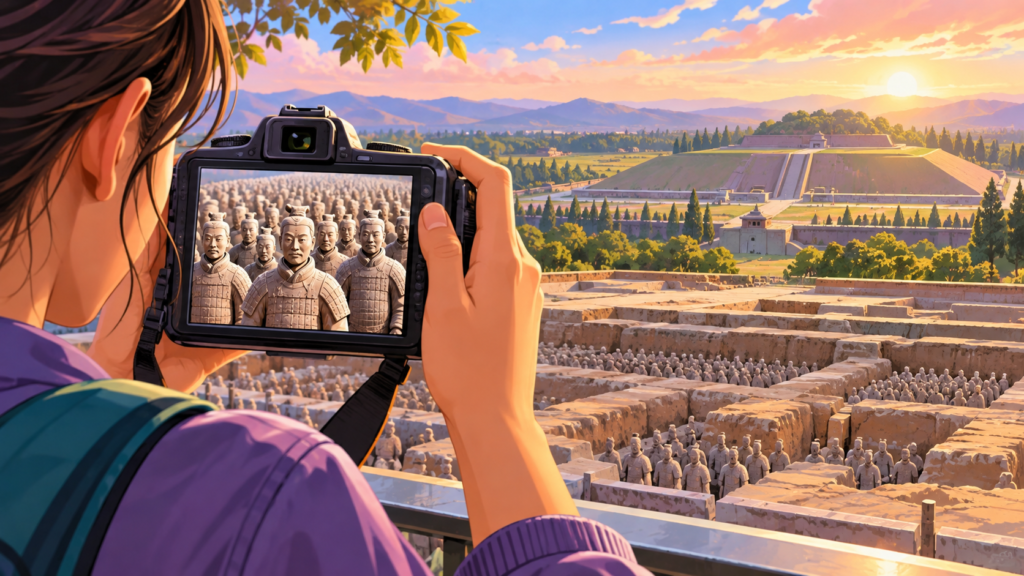
The camera loves rows of terracotta soldiers. A wide photograph can show rows of figures in formation; it is so memorable that it can become the entire story. Yet the army is only part of the mausoleum complex of Qin Shihuang near Xi’an.
UNESCO describes many accompanying pits, burial sites and remains spread across a large protected area. Horses, chariots, weapons and architectural traces appear in the archaeological record. The photograph of one pit is a doorway into that wider site, not a complete map of it.
The crop changes the question
If all you see are the soldiers, you might ask how many there are. Look at the larger landscape and you may ask why such a complex burial site was created, how work was organised and what archaeologists can know from objects left in place.
Those questions are harder. They need careful evidence, and a decorative statue cannot answer them alone. UNESCO’s account explains the site’s significance while distinguishing preserved objects from historical descriptions of the emperor’s plans.
Follow one object through the work
A closer view also opens a route towards making. A figure’s face, clothing and posture had to be worked into clay before the object became part of the buried complex. The finished army can hide those stages by presenting so many completed forms together.
A Metropolitan Museum account explores different explanations of construction. Some involve assembling separately made parts; another discussion examines experiments in building a coiled clay body. Added clay for carefully worked detail appears across the accounts.
That doesn’t give us a licence to pick one attractive method and call it settled. It shows what researchers are trying to recover from the objects themselves: not only their appearance, but the sequence of work that produced them. An experimental copy can test a possibility without proving every stage happened that way in antiquity.
The scale raises questions about organisation. Making one detailed figure and producing a large group require different kinds of planning. The objects provide evidence for investigating that work, though an impressive photograph cannot supply the missing instructions.
Horses and chariots widen the subject again. They ask the viewer to think about movement and equipment, even within a burial setting where the surviving objects no longer move. A harness detail can be as revealing as the overall formation.
There is a useful choice here for a museum display or a school project. You could organise it by object type, by place within the complex or by the process of making. Each arrangement would draw attention to something different in the same material.
The postcard view has earned its popularity. It gives you a powerful first impression. But the next photograph could bring the maker’s work into focus, or show how the army fits within the wider site. It needn’t compete with the famous image to add something the famous image leaves out.
What would you photograph second?
After the dramatic army view, choose a small feature: a horse’s halter, a tool mark or the edge of a pit. A close detail can remind us that this was built and buried, then discovered and studied. Its history did not end when the statues were made.
Famous places often come to us as one perfect image. Learning more begins when we ask what was outside the frame. There is almost always another room, another object or another person whose work made the photograph possible.
Look more closely at a terracotta face, then at a different material used to make objects: Why do terracotta soldiers have different faces? and How do you cast a pattern in bronze?.
Sources
- UNESCO World Heritage Centre: Mausoleum of the First Qin Emperor
- The Metropolitan Museum of Art: Yiren Shen: Making the Warrior, 10 July 2017