
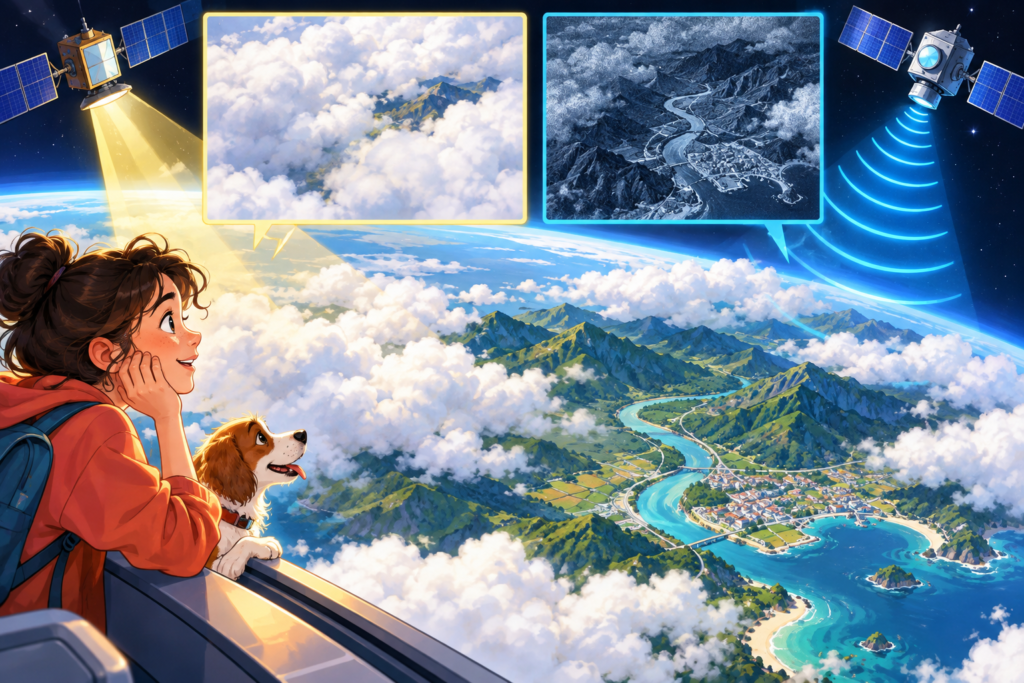
A normal photograph of Earth is stopped by a thick layer of cloud. Some satellites use radar instead of ordinary visible light; radar sends out microwave signals and measures what comes back. That can reveal parts of the surface through cloud and at night.
China’s Gaofen Earth-observation programme uses different kinds of instruments, not one magical camera. Other sensors measure reflected light in many bands and can help distinguish materials. The data still needs interpretation. A satellite image does not explain itself.
A signal, not a window
The useful difference begins with the instrument. A camera records light reaching it; a radar instrument sends a signal and measures its return. Changing that signal changes which obstacles matter and what information the surface can provide. It does not simply improve an ordinary photograph.
Gaofen-3 is a concrete Chinese example. CNSA’s August 2016 launch account describes a synthetic aperture radar satellite and intended uses including disaster monitoring and water-resource assessment. That dated announcement establishes the instrument’s purpose, rather than promising that the same spacecraft is supplying every image today.
ESA explains the same broad advantage through Sentinel-1: radar can acquire surface imagery through cloud and without daylight. Its account also describes combining observations to detect ground movement. Here, taking another image is part of the measurement, not merely collecting another attractive view.
Suppose two pictures of the same place appear different. The tempting explanation is that the place changed, but you also need to ask whether the instruments, viewing conditions and processing were comparable. Otherwise a difference in the picture might become an invented difference on the ground.
Colours need particular care. A bright patch in a processed radar image does not necessarily mean that the ground is visibly that colour. Before interpreting it, look for the key and the description of the measurement. The display is translating data into something a person can examine.
This makes satellite work a partnership between collecting and interpreting. An instrument can supply an observation that would be unavailable to a normal camera, while a researcher still has to connect it with a question. What changed? Over what interval? What other information would help explain it?
For an image used in a flood report, for instance, the date and location are part of its meaning. A clear view from an earlier day cannot automatically describe conditions during a later event. A cloud-free picture is useful only when it answers the right question at the right time.
Seeing through cloud therefore adds a way of observing Earth rather than removing every uncertainty. The most interesting images are those whose captions explain what was measured, allowing us to appreciate the view and understand its limits together.
Seeing is a kind of measuring
Imagine wearing glasses that reveal only temperature, then swapping them for glasses that reveal texture. Each view answers a different question and misses something else. Satellite instruments work on that principle at a far more technical level.
Earth observation can support useful work, while also raising questions about who controls data and how it may be used. The exciting part is not pretending a satellite sees everything. It is learning what each instrument can and cannot show.
Explore next
- Can a telescope listen to space?
- A call to the far side of the Moon
- Is two kilograms of Moon rock a lot?
Sources
- European Space Agency: radar vision
- China National Space Administration: Gaofen-3 SAR satellite launch, August 2016