
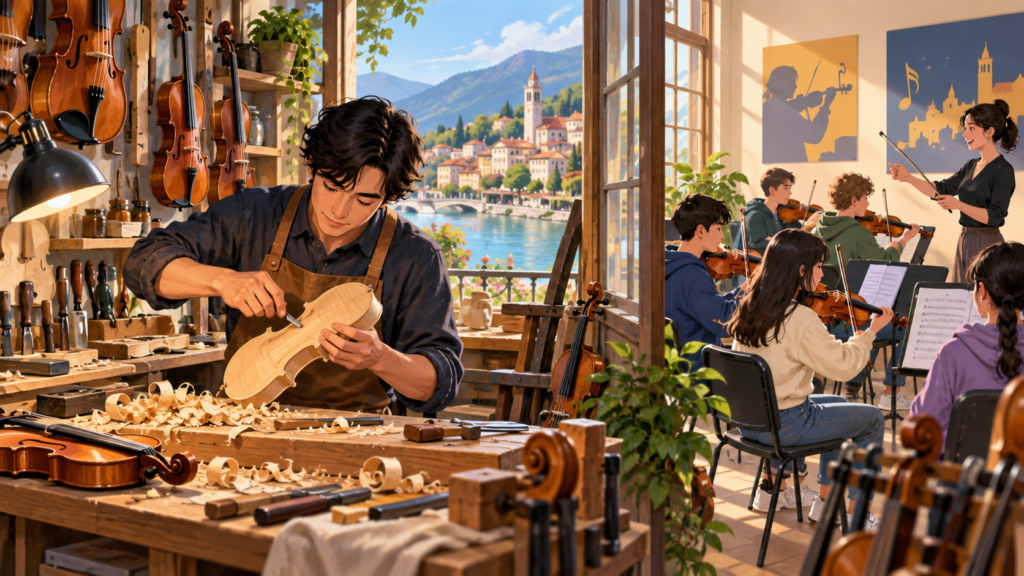
A stage performance might last an hour. Making the instrument and learning to play it can take years. UNESCO’s description of Wuxi, a Creative City of Music, includes instrument manufacturing, music education, orchestras, theatres and festivals. The city is associated with the erhu, but its makers also produce Western instruments.
Follow one instrument through the city
An instrument begins as something a person has to make. Before there can be a lesson or a concert, its parts have to fit together and perform their intended jobs. The workshop belongs to the musical story even when its work takes place far from an audience.
Wuxi’s profile lists both traditional and Western instruments among the city’s production, including erhus, harmonicas, harps and accordions. Their different forms make the phrase instrument manufacturing more meaningful: it covers several kinds of materials, construction and skill rather than one identical product repeated endlessly.
Then somebody has to learn to use what has been made. A first lesson may involve listening to a single sound and trying to reproduce it. Progress depends on repetition, feedback and the opportunity to practise. The public performance is the visible result of work that is often private and not especially glamorous.
A teacher connects those stages. They help a learner understand what the instrument can do and why a particular attempt is not yet producing the intended sound. The relationship is different from watching a demonstration: someone is listening to your effort and adjusting the advice to it.
Other work can keep the instrument in use. Maintenance, repairs, transport and a suitable place to practise are practical parts of participation. A city with concert halls but no accessible route into learning would offer a different musical life from one with lessons but few chances to perform.
That is why UNESCO’s description of Wuxi includes education and performance spaces alongside manufacturing. The activities support one another without becoming the same job. Buying an instrument, learning a tune and organising an event each requires a different set of decisions.
Economic descriptions need care, too. A city profile can record businesses and employment, but those figures do not reveal what every musician earns or whether every learner can afford lessons. A cultural industry can be significant while access still differs between people.
For a small project, follow one imaginary instrument from a workshop to a learner and then to a performance. At each stop, name the person whose work makes the next step possible. You will quickly have a fuller picture of a music city than a photograph of its largest stage could provide.
Making and playing an instrument also ask for different kinds of listening. A craftsperson listens for how a material responds; a learner listens for pitch and timing. The city profile places both activities in one musical world, which is more useful than imagining culture happens only under stage lights.
That range matters. “Music city” is not a claim that everybody likes the same tune, or that old and new sounds must compete. It describes an economy and a network of skills: a workshop, a teacher, a student making an unpleasant noise for the hundredth time, and eventually a concert. The numbers in a city profile may go out of date; the question remains interesting. If you tried to draw the route from an instrument maker to a person in the audience, how many hands would you include?
Explore next
Sources
- UNESCO Creative Cities Network: Wuxi profile