
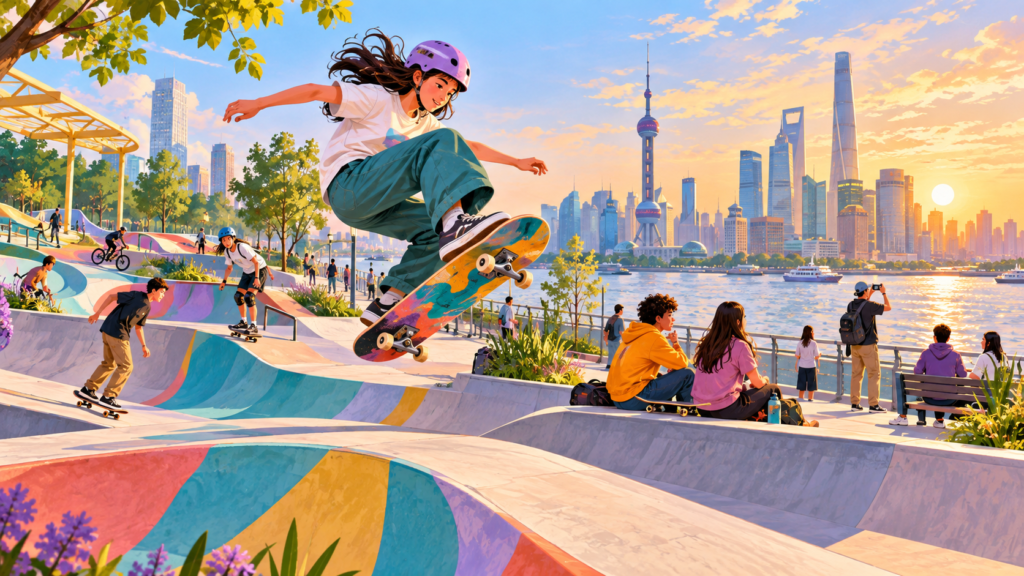
Think of a riverside walk. Do you picture benches and people taking photographs? Shanghai’s West Bund adds another possibility: skateboarding, pump tracks and other sports spaces along the Huangpu River.
In May 2026, a Shanghai government report described plans to expand the West Bund’s sports facilities, including a park under a bridge. Some parts were already built; others were plans for later dates. That distinction matters if you are tempted to draw a whole finished landscape from an announcement.
Space for more than one pace
Picture a skatepark beside a walking route: wheels, pauses between attempts and perhaps a cheer when a trick works. It suggests a different rhythm from a space used only for passing through. A person walking past can watch without needing to join. A good public space leaves room for both.
The report quoted an organiser saying that nearly 20 public sports facilities and spaces had been built in the West Bund area. That is not a guarantee they were all equally easy to reach or suitable for every age and ability. It is an invitation to ask how the spaces are actually used.
What happens between the competitions?
The report’s proposed park under Xupu Bridge gives the question a concrete setting. The plan described roughly seventeen thousand square metres and connected professional events with everyday leisure. Using space beneath a bridge also asks us to see infrastructure as somewhere people might spend time, rather than only something above their heads.
A proposal tells us the intended use. To judge the eventual place, we would need to know what was built and how people experienced it. The May announcement doesn’t supply that later evidence. Its planned July skatepark reopening should not quietly become a claim that every upgrade was completed.
There are several useful questions to take beyond the announcement. Can someone find the entrance easily? Is there somewhere to pause without joining a sport? How does a beginner learn what is expected? Those aren’t accusations about this project; they are ways to think about the difference between a striking design and a usable space.
Sport and walking also involve different movements. A person practising needs room to repeat an attempt, while someone passing through may simply want a clear route. An interesting riverfront has to accommodate more than one reason for being there.
The organiser’s figure of nearly twenty sports facilities suggests variety, but a count doesn’t describe every user’s experience. Two spaces can serve quite different purposes even when both appear under the same heading in a report. We should ask what each one offers before treating the number as an answer.
The big competition provides a reason to plan and attract attention. The ordinary afternoon provides another kind of test. Someone who returns to practise, meet a friend or watch from a bench gives the place a use beyond the event’s timetable.
That is the part of the West Bund idea worth following: how a setting prepared for a major occasion might also make room for smaller, repeated visits.
Who has the right to practise?
One of the hardest parts of a sport is looking bad at it in public while you learn. A welcoming place lets beginners do that. If a new riverfront only looks beautiful in photos but makes people feel they cannot try anything, it is missing something.
West Bund’s sporting plans were linked to major events, but the everyday question is more interesting: after the cameras leave, can local people still roll, walk, rest and meet by the river? That is how a big project becomes part of ordinary life.
Two other public-space stories look at pavement parking and a riverside park: Who owns the pavement after a bike ride? and The Jinhua park designed to let floodwater in.
Sources
- Shanghai Municipal Government: West Bund aims to become sports hub through Olympic Q-Series