
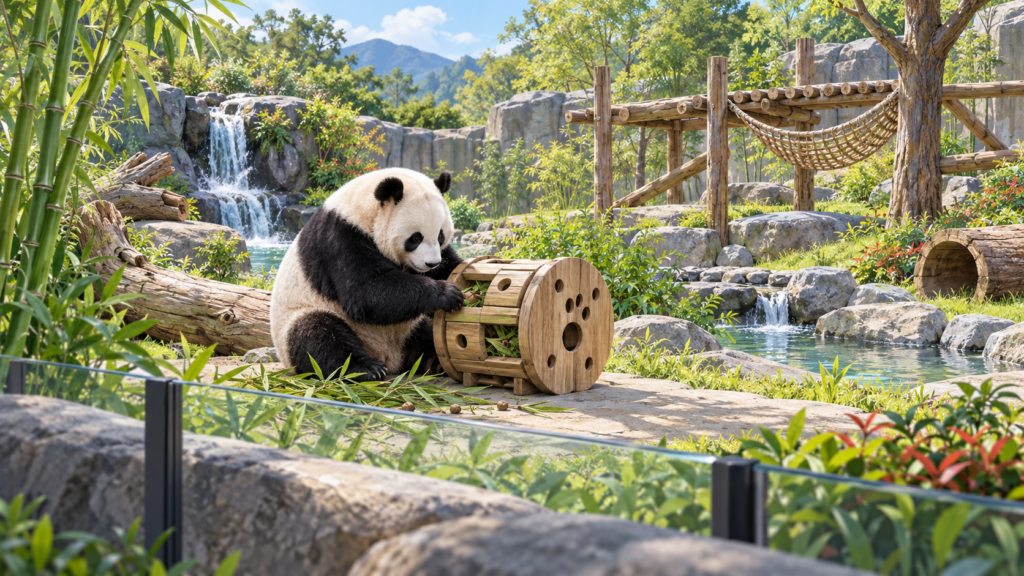
If you were asked to design a panda’s day, you might begin with bamboo, somewhere shady and a comfortable place to sleep. Then comes a harder question: what can the panda choose to do after breakfast?
The Chengdu Research Base of Giant Panda Breeding describes an education activity called the Giant Panda Enrichment Designer Experience. The word “designer” sounds as though a panda might be getting a new outfit, but the interesting work concerns its surroundings and behaviour.
Enrichment gives an animal opportunities to use behaviours that suit its needs. A thing that looks amusing to a visitor isn’t automatically a useful addition to the animal’s day. The panda, rather than the photograph, has to be the starting point.
Your idea isn’t automatically a panda’s idea
Imagine being given a drawing of an enclosure and asked to add one object. You might put it beside the viewing area so people could see it clearly. But if the animal would benefit from investigating somewhere quieter, the best place might be farther from the audience.
That changes the design problem. You aren’t arranging a stage on which the animal must perform. You are trying to offer something it can use, with safety and its individual response in mind. The result may be interesting precisely because the animal doesn’t use it as a person first expected.
A keeper’s account from the Smithsonian’s National Zoo offers concrete examples. In 2021, Nicole MacCorkle described placing scents in panda habitats for the animals to discover, and using puzzle feeders that pandas could roll, spin or shake to obtain food. The aim was to encourage exploration and foraging.
A puzzle feeder is therefore different from putting a snack where it is immediately accessible. The panda’s actions become part of reaching it. That doesn’t give visitors permission to invent their own feeder or throw in food; trained staff decide what is suitable.
The same keeper described individual preferences among the animals in her care. That is an important detail for a designer. A general idea about giant pandas provides a beginning, but observing a particular animal helps show whether a particular activity works for it.
Looking carefully is part of the job
The Chengdu base places its designer activity alongside courses about panda diets and what researchers can learn from droppings. Those may sound like very different lessons, but they share a practical starting point: learning about an animal requires attention to what it does and what it needs.
An attractive drawing can’t answer every question. Does the panda investigate the object? Does it use an opportunity repeatedly or ignore it? What do the people caring for it notice over time? Those are useful questions to ask about a design, rather than claims that we have evaluated a particular enclosure ourselves.
It can be tempting to interpret every movement as a human mood. An animal turning away from visitors isn’t necessarily making the joke imagined in a caption. A short clip shows a moment; keepers have a much longer view of its routines and responses.
That distinction matters because caring for a panda continues when the audience has gone. A popular photograph may draw attention to conservation, but the daily work includes details that wouldn’t make a dramatic picture at all.
The visitor’s view comes second
Chengdu’s visitor guidance describes a trial of rotational rest days in a heavily visited area. It also explains that animals or areas may not be visible because of conservation, weather or management needs. The notice makes clear that the view available to visitors isn’t the only consideration.
The base prohibits feeding animals, loud noises and camera flashes. Following those rules is a visitor’s practical contribution; being enthusiastic about pandas doesn’t make an exception sensible. You can enjoy watching without trying to direct the animal’s attention.
At a zoo or wildlife centre, a useful question is what opportunities an animal has to explore, rest or move away. You may not be able to answer it fully from a path, but it changes what you look for.
The best panda design might be one that makes a visitor’s view less convenient and the panda’s day more interesting. That is a rather different ambition from making sure the animal is always ready for a close-up.
Two other panda stories look at everyday care and a snowy day: Why would a panda keeper make a toy? and Do giant pandas enjoy snow?.
Sources
- Chengdu Research Base of Giant Panda Breeding: Brief introduction
- Chengdu Research Base of Giant Panda Breeding: Visitor’s Info
- Smithsonian's National Zoo and Conservation Biology Institute: How to Care for Giant Pandas, 6 August 2021