
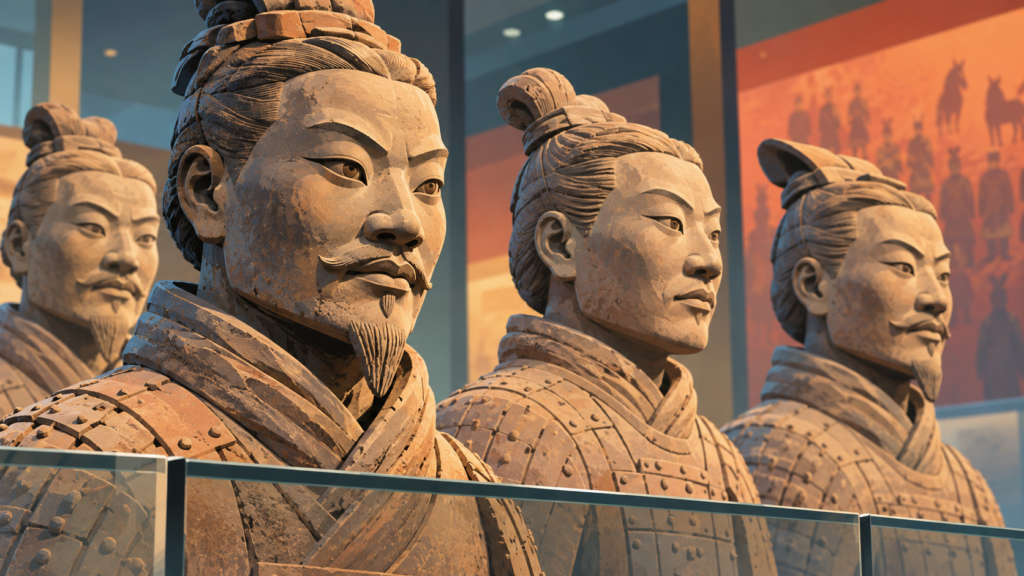
Rows of terracotta soldiers are easy to turn into a single impressive number. Stop at one face instead. The brows, hair and expression ask a more interesting question: how did makers produce so much detail across so many figures?
The army belongs to the mausoleum of Qin Shihuang, the first emperor of a unified Chinese empire, near Xi’an in Shaanxi province. UNESCO describes thousands of life-size soldiers and horses in accompanying pits, with details of uniforms, equipment and even horse harnesses.
An army made by people
The sculptures are not real soldiers frozen in time. They are works made for a ruler’s tomb, reflecting the skills and choices of craftspeople. A face that looks individual makes you notice the hand behind it, even though we cannot simply read a maker’s name from every figure.
UNESCO treats the wider site as more than the famous pits. There are burial areas and other remains. The tourist photograph often crops out that larger setting, which can make the army look like an attraction built only to astonish us.
Different isn’t the same as a portrait
Some of the answer lies in the finishing. Research discussed by UCL identifies moulds used for the basic shape of some parts, followed by changes made by hand. A shared starting shape need not lead to an identical finished face. Hairstyles and other details could be altered.
That is familiar from making things yourself. Two clay pieces can begin from the same cutter while the work done afterwards gives them different expressions. The comparison helps explain a possibility; it does not recreate the exact method of every ancient workshop.
Researchers have also asked whether the figures portray real individuals. In one UCL project, digital photographs were used to build three-dimensional models and compare thirty sculpted ears. None in that sample was identical to another.
It is an appealing result, but the researchers explicitly warned against reversing the reasoning. Portraits of different people might have different ears; different ears do not prove that the figures are portraits. Craftspeople could produce variation without recording a particular person.
The making process has its own debates. A Metropolitan Museum article compares explanations involving moulds, separately made parts and coiled clay, alongside experimental reconstructions. Those accounts differ about construction, but the discussion repeatedly returns to added clay used to carve details.
An experiment can show that a method is possible. It takes further evidence to establish that it was the method used for an original object. That makes the research more interesting than a single diagram pretending every question has been settled.
The face therefore carries two sorts of individuality: the details you can see and the historical identity you might be tempted to imagine behind them. The first is there to study. The second needs evidence. You can admire the maker’s skill without giving the soldier a biography that nobody has recovered.
What would you sketch?
If you drew one figure, you could begin with the folds of a uniform rather than the whole army. The detail could reveal how the sculpture was designed, while conclusions about actual historical soldiers would still need archaeological evidence.
The scale is extraordinary. But the more you look, the less the figures seem like one repeated statue. A huge historical site becomes easier to approach when you let a single carefully made face ask the first question.
The wider terracotta collection and a story about bronze offer two more ways to study a made object: Beyond the terracotta army postcard and How do you cast a pattern in bronze?.
Sources
- UNESCO World Heritage Centre: Mausoleum of the First Qin Emperor
- UCL Imperial Logistics research project: The terracotta warriors and the portrait debate, 5 December 2014
- The Metropolitan Museum of Art: Yiren Shen: Making the Warrior, 10 July 2017