
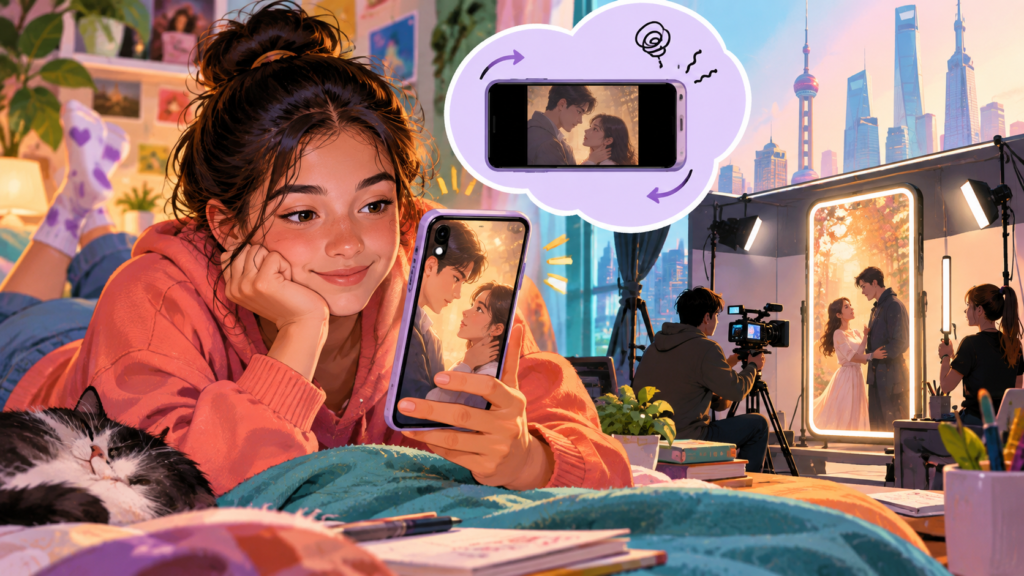
Turn your phone sideways to watch a video and you immediately understand the small effort that a vertical drama removes. The story fits the screen as you normally hold it. But making a drama for an upright frame means more than trimming the sides off a television programme.
Shanghai’s January 2026 account of micro-drama studios describes a production scene built around these short online series. Some studios have acquired the nickname shudian, or vertical studios. The name plays on Hengdian, the production centre associated with conventional film and television.
The joke points to a practical change. A different-shaped frame gives the people making a scene different choices about what the viewer can see at once.
What fits beside a face?
Imagine two characters standing far apart at opposite ends of a room. A wide shot might show both comfortably. In a narrow upright picture, the same arrangement could leave you looking mainly at the space between them. You would have to decide what the scene really needs.
Perhaps a close view of one person’s reaction would tell the story better. Perhaps seeing the other character enter behind them would be the important moment. These are imagined filming choices, but they help explain why the shape of the screen belongs in the planning.
A phone message, a face or an object in somebody’s hand could become the focus. A large setting may still matter, but it doesn’t have to fill the picture in the same way. Designing for a frame and cropping a finished scene are different tasks.
The result isn’t automatically intimate or exciting. If the viewer can’t understand who is speaking or why an action matters, a close-up alone won’t rescue it. The frame is a tool for telling the story, not a substitute for knowing what the story is.
Small episodes still need real sets
Shanghai’s report describes the International Short Video Center in Jiading, developed from an internet-advertising production base in a former manufacturing plant. Its indoor sets let crews work in different sorts of surroundings, including homes and period-style interiors.
That detail complicates the idea that anything short must be casually filmed in someone’s bedroom. A brief episode can still involve choices about rooms, lighting, costumes and how people move within the scene. The audience may see a small screen, while the work takes place in a much larger space.
Nor does a professional set prove that the finished writing is good. It tells us something about how a production can be organised. The quality of a character or conversation remains another question.
A short format makes those decisions particularly noticeable. Imagine an episode in which someone is about to open a letter. If the episode ends there, you may return because you care who sent it. If you don’t care about the person holding it, stopping before the answer may simply be irritating.
Why come back for the next part?
Shanghai announced support for AI-assisted micro-drama production in May 2026. The measures described help with tools, services and production, among other areas. An announcement shows what the city planned to support; it doesn’t tell us what viewers will enjoy.
That leaves a useful question when watching any short series: what is making you want the next part? It could be a character you like, a problem you want resolved or a scene that made you laugh. A cliffhanger can invite you onwards, but something in the story needs to make the invitation worthwhile.
You might enjoy one series in short bursts and prefer another on a larger screen. The choice doesn’t have to become an argument about which kind of television is more serious. Different formats give makers and viewers different possibilities.
Next time an upright clip looks as though someone has chopped a normal programme in half, look again. Its scene may have been designed around that narrow frame from the beginning. The small picture can contain plenty of deliberate choices.
Explore next
Sources
- Shanghai Municipal Government: Short drama boom fuels rise of Shanghai’s film studios
- Shanghai Municipal Government: Shanghai to support quality development of AI-powered micro dramas