
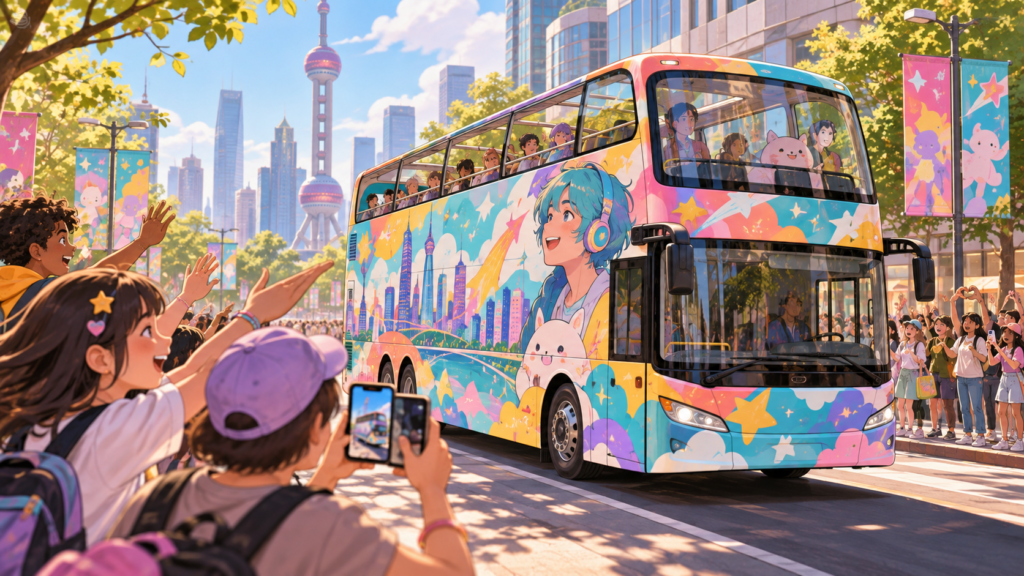
You expect a themed shop to stay where it is. In Shanghai’s summer 2026 animation and gaming programme, one attraction did the opposite: a branded double-decker sightseeing bus was planned to travel a city route as part of the Joy Universe event in Jing’an district.
The bus was one piece of a much wider programme of games, web novels and character brands. A themed metro installation was also planned. The idea was to take fandom beyond an event hall and into spaces people normally use to get somewhere else.
A city becomes the display
Think about what changes when a game or character appears on a bus. People who bought event tickets may enjoy recognising it. Other passengers might have no idea what it means. The bus still has a route; the decoration does not turn every journey into a fan experience, but it can make an ordinary street feel briefly connected to a story.
Shanghai’s programme also mapped sub-venues across several districts, from shopping centres to fairs and pop-ups. That suggests a different kind of day out from visiting one enormous convention hall. You could discover something on the way to another stop, although some activities would have had their own access rules and dates.
The street has other stories on it
Imagine seeing a favourite character from across the road. For a fan, it might be an invitation to look again. Someone beside them may be more interested in whether the bus is theirs, where the crossing is or how to reach a shop. A single scene can contain all those purposes.
That is what makes a moving display different from a themed room. In the room, people have chosen to enter the attraction. On a street, an image can reach people who didn’t come looking for it. Recognising the design becomes optional, rather than a condition of using the place.
The Shanghai programme described a sightseeing bus, so we shouldn’t turn it into an account of a decorated commuter service. The distinction matters when picturing who might board. Something can appear in ordinary city space while remaining part of a specific organised attraction.
There is a similar difference between a metro installation and a station turned entirely into an event. The programme mentioned decorated columns in a station hall. That is one planned use of a surface within a space that still has its own practical purpose.
A fan might stop to notice a design; another passenger might walk past it. A good description leaves room for both, rather than imagining a whole crowd sharing the same enthusiasm.
The route gives the idea another layer. Instead of a person travelling to a still image, the image can pass through several settings. From the pavement, someone may see it briefly; on board, a visitor would have a different view and a different length of encounter.
We don’t need to claim what particular passengers felt to see that those positions matter. Where you stand changes how you meet a display, just as knowing the character changes what you recognise.
The date matters, too. The published plan is evidence that organisers proposed taking the event into these places in summer 2026. It isn’t evidence that you can find the same decorated vehicle by following an old listing today.
Where would you put the next clue?
This feels a little like a citywide treasure hunt. Yet the city is not a game board invented for fans; people live and work along that bus route. The best version of such an event would be playful without assuming everybody wants to take part.
The route might have changed after the programme announcement, so this is a story about the 2026 idea rather than travel advice for today. It leaves a good question: if your favourite story could borrow one part of your town for a day, would you choose a bus, a station or somewhere completely unexpected?
Art on the metro and small fandom objects offer two other encounters with shared images: Can a train become an art gallery? and What is guzi, and why do people collect it?.
Sources
- Shanghai Municipal Government: Game on: Shanghai’s summer of animation and gaming begins