
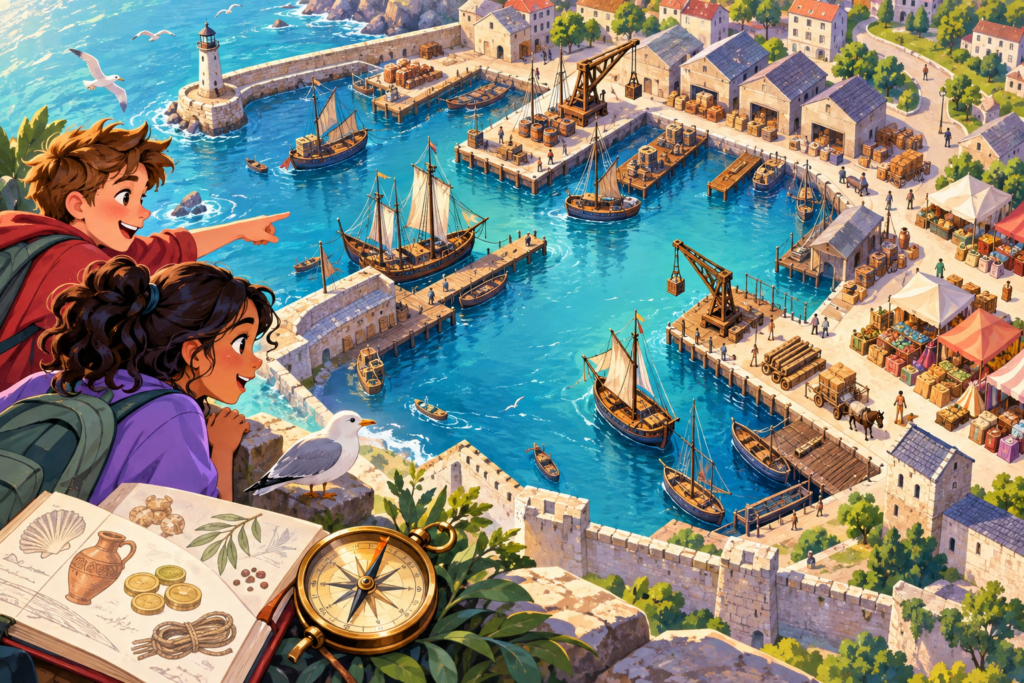
If you searched for an old port, you might expect a row of boats. Quanzhou’s UNESCO World Heritage listing asks you to look much farther: at bridges, religious buildings, docks and the systems that connected a city to maritime trade during the Song and Yuan periods.
Goods moved, but so did people, beliefs, skills and languages. A port is where the story of a city meets the story of distant places. Quanzhou’s surviving sites do not say that everyone got along perfectly; they show a complicated network that needed workers, merchants, officials and communities.
Follow a cargo before it reaches a boat
UNESCO places Quanzhou’s maritime importance within the tenth to fourteenth centuries. Its heritage property joins several sites rather than asking one surviving quay to stand for the whole trading city. The parts explain different jobs within the network.
Ceramic and iron-production sites begin one possible trail. Goods had to be made before they could be moved and sold. Looking inland from the harbour therefore changes the question from “Where did ships arrive?” to “What connected production with the water?”
Bridges and docks carry the next part of that explanation. A dock is useful because goods and people can reach it; a bridge helps connect routes on land. These structures belong together when you consider the journey of a cargo rather than admire each as an isolated monument.
Administrative buildings point towards organisation. Trade needs arrangements as well as movement, and the surviving sites give researchers evidence for how the port’s institutions occupied the city. A ruined building cannot reproduce every transaction, but its place in the network can help frame the right questions.
Religious buildings and memorials add another dimension. The listing includes the Qingjing Mosque and Islamic tombs alongside other kinds of site. They help document communities connected with Quanzhou’s history. Their survival does not prove that every relationship between communities was easy or equal.
To explore the idea, sketch a fictional harbour and place a workshop some distance inland. Add a route to the water, a crossing and a dock. Now consider what the people working there would need in the surrounding town. Your drawing quickly becomes larger than a row of ships.
That is the value of reading Quanzhou as a connected property. Production, transport and community leave different traces, and none can explain the port alone. A boat may provide the most immediate image of maritime trade, but the city beyond the waterfront makes its journey possible.
The listing notes the name Zayton in Arabic and western texts of the period. Different surviving names can help researchers connect written accounts with the same trading centre.
The harbour beyond the water
Try drawing your own “port map” with no ships on it. Add the roads, places of worship, warehouses, workshops and homes that would make trade possible. Suddenly the city becomes the harbour’s most important equipment.
It is easy to call an old trading city “cosmopolitan” and stop there. It is more interesting to ask what the different buildings reveal about who could arrive, stay, work and belong.
Explore next
- A French pastry with a Shanghai address
- Can a train become an art gallery?
- What would you eat at a Beijing night market?
Sources
- UNESCO World Heritage Centre: Quanzhou: Emporium of the World in Song–Yuan China