
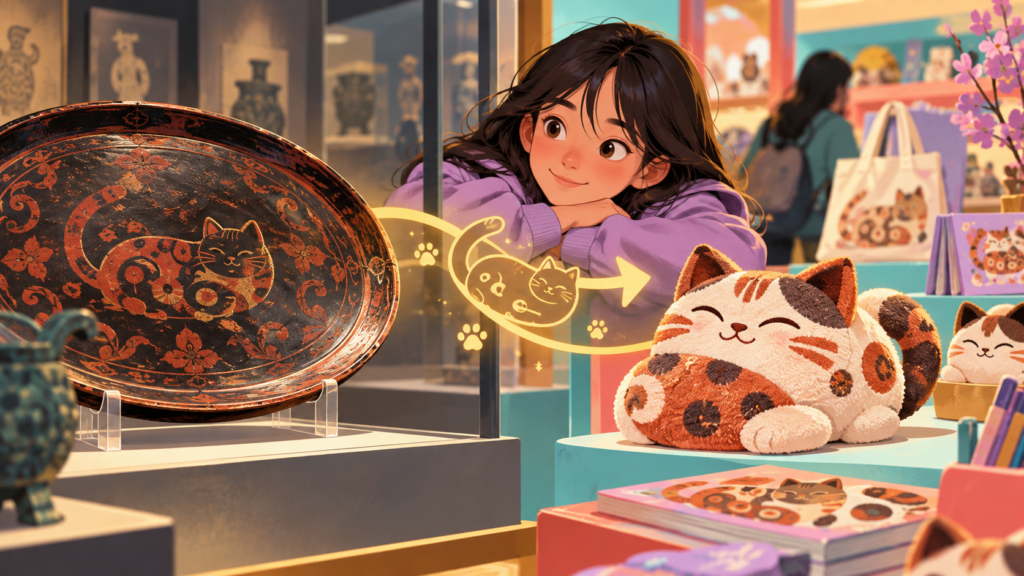
Somewhere between a Han-dynasty lacquer tray and a museum shop, a cat became cuddly. Shanghai’s cultural authority described a modern plush inspired by a cat motif on a food tray excavated from Xin Zhui’s tomb at Mawangdui.
The toy belonged to merchandise associated with a 2026 exhibition at the China Art Museum in Shanghai. It came in different colours and sizes and contained mugwort, according to the guide. The detail that makes it especially interesting isn’t the stuffing, though. It is the journey from a design on a tray to an object you can hug.
The ancient object and the new one share a starting point without becoming the same thing. Looking at that difference is part of the fun.
A cat in another material
Imagine beginning with a small motif on the surface of a tray. Turning it into a soft toy would mean making choices the original object didn’t require: how thick to make it, what its back looks like and how it should sit when somebody puts it down.
Those imagined design problems help explain the word “inspired”. A maker isn’t simply lifting the ancient object out of its setting. They are choosing parts of a design and giving them another form. What was once noticed on a surface can become the thing somebody notices first.
The new cat doesn’t tell us that Han households had this kind of plush toy. Nor can it establish what the original motif meant to the person who owned the tray. We need evidence about the historical object for those questions, rather than answers supplied by the souvenir’s modern expression.
It is easy to enjoy the soft toy while keeping that distinction. You can like its colours and still want to know where the starting image came from. The adaptation can begin the conversation without finishing it.
The tray’s purpose matters, too. It was a food-serving object with a motif on it, rather than an object designed to become this modern toy. The new use changes how someone encounters the image.
Hunan is part of the story
Mawangdui is in Hunan province. The Shanghai exhibition brought objects associated with its Han tombs to another city’s audience. The difference between the findspot and the exhibition venue matters: a museum can introduce material from somewhere else without making its history local to that museum.
Shanghai’s July 2026 guide connected the exhibition with several modern products. Fridge magnets drew on cat motifs and a T-shaped silk painting; scarves and bags used Han-period patterns. Those choices offered different ways for a detail from the exhibition to appear in everyday life.
They also changed the scale. A pattern on a large or delicate historical object can be selected, reduced or repeated on something portable. The result may help you remember the exhibition, but it can’t show everything about the original material, purpose or setting.
That is a good reason to look back at an object label or the museum’s explanation. The product tells you what a designer chose to carry forward. The historical account can tell you what has been left outside that choice.
Let the souvenir send you back
The same Shanghai guide described other museum products, including fuse-bead designs inspired by objects in a Minhang Museum exhibition. A small modern craft and an older object can look very different while giving someone a route between them.
The useful test is what happens after you notice the souvenir. Does it make you want to find its source? Could you explain which detail has travelled and which parts belong to the new design? Those questions give a playful object a second use, beyond decorating a shelf.
You don’t need to buy the cat to follow that route. A picture and a clear explanation can be enough to make you curious about the tray. Nor does liking the toy mean you have to pretend it is an exact historical copy.
The cuddly version may be the first thing that catches your eye. If it sends you looking for a small cat on an older food tray, it has done something rather worthwhile: made a detail worth finding twice.
Explore another encounter with Han-era objects and a closer look at a lacquer box: What happens at a Han-dynasty dinner in VR? and Can a tree become a shiny box?.
Sources
- Shanghai Municipal Government: Shanghai museums get creative with cultural merchandise