
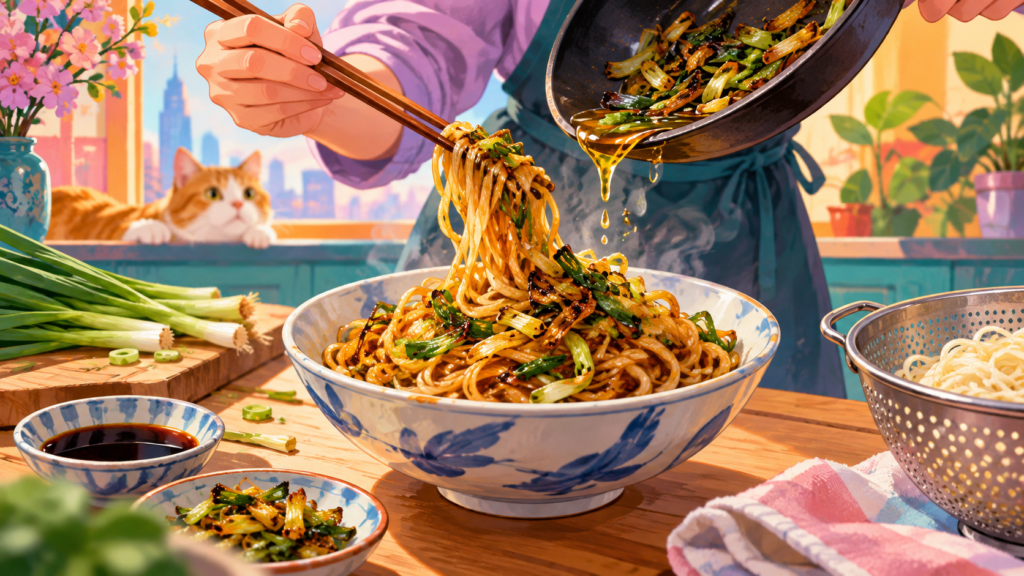
There is nowhere for a weak ingredient to hide in a simple dish. Shanghai’s scallion oil noodles bring together noodles, oil scented with scallions and soy sauce. The city’s 2026 guide describes slowly frying small scallions until they turn golden and fragrant, then tossing the noodles so each strand gets coated.
That final mixing step sounds almost too ordinary to mention. It is probably the reason one forkful tastes right and the next does too.
The smell arrives first
Frying the scallions gently changes the oil. Add the noodles and the aroma reaches the table before you have lifted a bite. Some versions include extras, such as dried shrimp; the basic idea does not need a tower of toppings.
The Shanghai guide gives a historical account of the dish, including a named nineteenth-century cook. Food origins are often messier than one neat invention story, so it is best treated as the guide’s account rather than a fact that erases earlier noodle traditions.
Mixing is part of the method
The guide distinguishes light and dark soy sauce. It describes the former as adding a saltier taste and the latter as deepening the colour. Two bottles that share a broad name can have different jobs in the same bowl. The dish’s simplicity doesn’t remove those decisions.
The noodles also have to carry the oil and sauce. The city account favours fresh-cut noodles with a smooth, chewy character. Its description is about the relationship between the strand and what coats it, rather than the noodle functioning as an anonymous base for toppings.
When the bowl arrives, mixing spreads those ingredients. The guide suggests lifting and loosening the noodles so they are coated evenly. That gives the diner a small part in finishing the dish, even though the work of frying the scallions has already happened.
Imagine leaving one section untouched while another is thoroughly mixed. Your spoonfuls could meet different proportions. The point isn’t to impose a table ritual, but to see why a seemingly ordinary movement might change the experience.
The additions complicate the headline in a useful way. Dried shrimp appears in the guide, while some shop examples offer other toppings such as an egg. Three main ingredients can describe the basic idea without being a promise that every version contains only three things.
That matters when ordering as well as when writing about the meal. A short name may tell you the style, but asking about the particular version tells you more about what will be in the bowl. Simplicity in appearance shouldn’t lead us to guess every ingredient.
The appealing challenge is how much difference a small adjustment can make. You don’t need a new shape or an elaborate garnish to produce another version. Changing the balance, the strand or an extra topping gives the same familiar idea another possibility.
A meal you can pay attention to
If you had to compare two bowls, what would you judge? The strength of the scallion flavour, the chew of the noodles, how the sauce clings or whether the oil feels too heavy? Those questions make a plain-looking dish surprisingly detailed.
Not every meal has to arrive with a dramatic reveal. This one asks you to notice the small choices a cook made. Perhaps that is why simple comfort food is so difficult to copy exactly: the ingredients are easy to name, but balance is not something you can read off a list.
These two noodle stories focus on a different cooking surface and a different way of making the noodles: What makes beef noodles worth watching? and Can noodles get their bounce from bamboo?.
Sources
- Shanghai Municipal Government: Scallion oil noodles: A taste of simplicity and flavor