
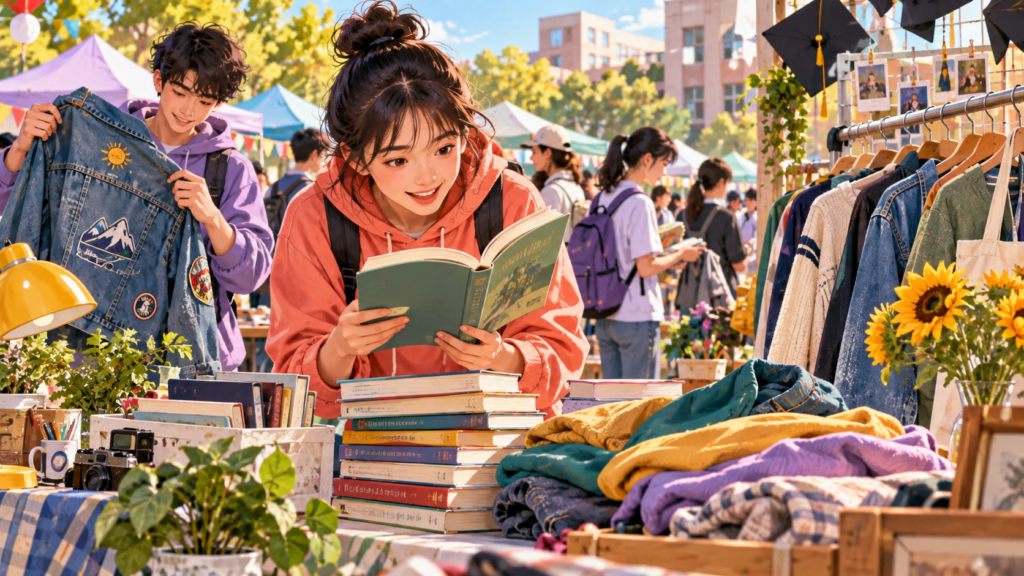
Somebody’s unwanted textbook can be exactly the one you need. A second-hand jacket can have more character than a new one. Shanghai’s official student guide says campus flea markets often appear around graduation, when students sell things they cannot or do not want to take with them.
The appeal is obvious: lower prices, fewer useful objects thrown away and the small thrill of finding something unexpected. But a good treasure hunt also involves looking closely. Is the book the right edition? Does the item work? Is it clean and safe to use?
A different owner, a different use
Graduation is a useful moment for reuse because two people’s plans can fit together. Someone leaving a room no longer needs its storage box; someone arriving may need exactly that space. The object can remain useful even though the first owner’s circumstances have changed.
Books make the idea particularly clear. A cover can look right while the edition is wrong for a course. Notes might help one reader and distract another. The best purchase depends on what the next person needs, not simply on how cheap the book appears.
The Shanghai guide encourages clear descriptions of condition and defects. That shifts some responsibility onto the seller: a useful listing should explain what a buyer cannot easily tell from one flattering photograph. Missing parts deserve mentioning before somebody agrees a price.
Imagine two descriptions of the same bag. One says “great bag”; the other explains its size and points out a damaged zip. The second may sound less exciting, but it gives a buyer something to assess. Honesty makes it easier to decide whether the object can still do the intended job.
A low price can be tempting even when you do not need the item. Before treating it as a bargain, ask where it would go and when you would use it. Buying something that becomes your own unwanted object has only moved the problem.
Online transactions add a different layer from browsing a supervised stall. A photograph is not an inspection, and a friendly message does not establish that a stranger is trustworthy. The guide stresses keeping transaction records and protecting personal information. Younger readers should involve a parent or guardian rather than arranging meetings or payments alone.
Reuse works best when the object, the description and the next owner’s needs line up. There can still be room for a surprising find, but surprise does not need to replace the ordinary questions that make a purchase useful.
Ask, inspect, decide
The city guide also discusses online second-hand platforms and practical checks. If you are a teenager, buying online should involve your parent or guardian and the platform’s age rules; strangers and payments deserve more caution than a funny listing deserves trust.
At a supervised school sale, the questions are easier. Ask what condition something is in, why the seller no longer needs it and whether you can examine it. A polite “no thanks” is better than a purchase you regret.
The Shanghai guide is aimed mainly at students studying in China, not at every fifteen-year-old in every city. Its useful idea is wider: reuse can be social as well as practical. The best find may be a book with the right notes, a jacket that fits perfectly or a story about where it came from.
For more student perspectives, continue with a walk through Shanghai and a meeting between young visitors: Can students design a better city walk? and What would you ask at a friendship camp?.
Sources
- Shanghai Municipal Government: A guide to second-hand trading for students in China