
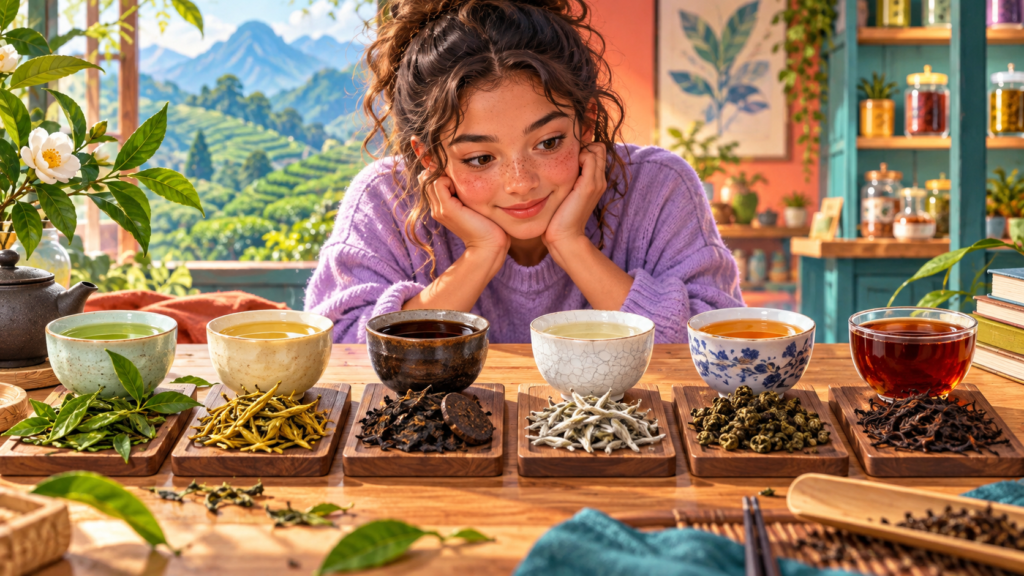
Ask for “tea” in a British café and somebody might assume you mean a familiar dark brew, possibly with milk. That is only one tiny corner of the tea world. UNESCO’s description of traditional tea processing in China names six broad categories: green, yellow, dark, white, oolong and black.
Those are not six identical drinks with differently coloured labels. The people making tea choose when to pick leaves and how to handle them afterwards. Place, weather, skill and processing all change the result. There are also flower-scented and other reprocessed teas, so even the six-category list is a beginning rather than the entire shelf.
The leaf has a journey
UNESCO’s account links tea to growing, picking, processing, making and sharing a drink. When you only see a teabag, most of that journey disappears. It is a bit like seeing a finished photograph and forgetting that someone chose the light, the frame and the moment.
The account also notes that tea can be served in homes, restaurants and other places, and that sharing it can be part of social life. That does not mean every person in China drinks tea in the same way. It means a drink can carry many local habits, and the label “Chinese tea” is much too large to describe one taste.
A category isn’t a tasting note
The six names help organise a very large subject, but they don’t tell you everything about a cup. Saying that a tea belongs to one category still leaves questions about its maker, its ingredients and the way it has been prepared. A family tree is useful even when each member has a different personality.
UNESCO’s account describes more than two thousand products when reprocessed teas are included. That is a count given in its description, rather than a new survey of everything on sale today. Even so, it explains why six categories cannot mean six flavours. There is room for considerable variety within and beyond the list.
Flower-scented tea offers an easy example of another decision. The drink’s description tells you that a scent has become part of the product. It doesn’t let us assume that every tea in the same broad family smells like that, or that every maker uses the same method.
There are people behind those distinctions. Growing plants, choosing leaves and processing them are different parts of the work. The knowledge is passed through families and apprenticeships, according to UNESCO. Someone learning the craft needs more than a list of six names; they need to understand what to do with the material in front of them.
The account includes people who make pastries served with tea among the tradition’s bearers. That widens the picture beyond the drink itself. Something accompanying a cup can be part of the occasion, although it would be wrong to turn that example into a rule that everyone must serve it.
If you were making a little tasting notebook, you could separate what a label tells you from what you notice. Record the category first, then describe the colour or aroma in your own words. Preferring one cup doesn’t require declaring another inferior. It simply gives you a reason to ask what made the difference.
What would you compare?
You do not have to become a tea expert to notice the difference. Smell two varieties, look at the leaves and ask how each was made. Even if you decide you prefer hot chocolate, you will have learned that “tea” is a family name, not a single personality.
The same question is useful with foods too: what part of a dish is shared, and what changes from one place to another? A mooncake with pork inside is a good reminder that familiar names can hide very different flavours.