
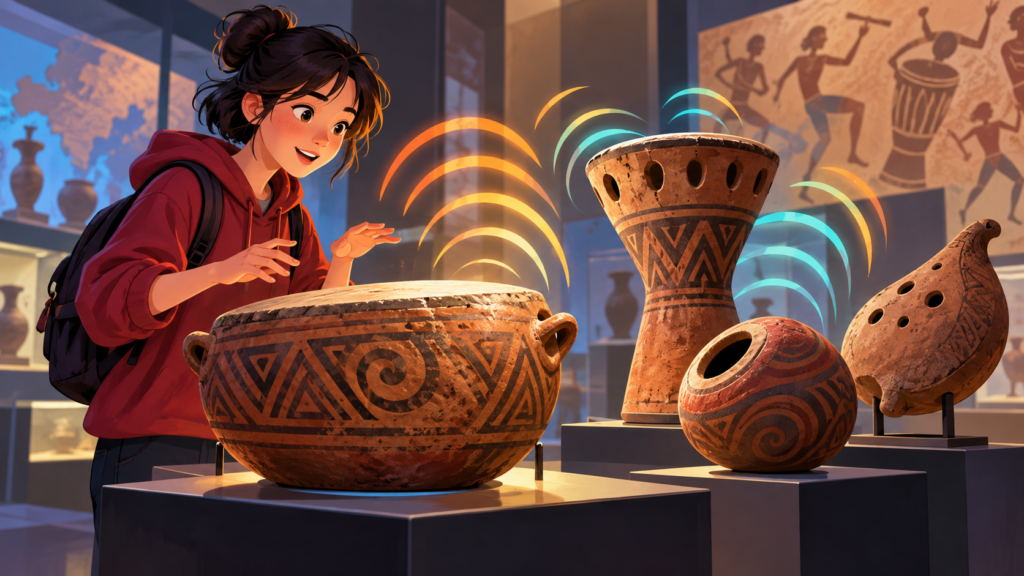
Imagine finding an instrument but having no recording of its music. UNESCO’s Wuxi profile describes hundreds of pottery percussion sets from the Hongshan archaeological site, evidence of musical activity in the area more than 2,500 years ago. The objects have lasted; the exact performances have not.
Look closely before trying to listen
An instrument is evidence of several kinds of work. Somebody selected a material, shaped it and produced an object that could be used to make sound. Its surviving form can therefore tell a story even when nobody can recover the exact piece once played on it.
The first questions are physical. What parts are intact? Which surfaces show traces of making or use? Were the objects found together, or has a display brought them together later? Those details help distinguish the surviving evidence from the arrangement you happen to see in a museum.
Sound introduces another problem. A modern replica can test what a particular reconstruction allows, but its materials and dimensions need to be recorded. Change the object and you may change the sound. A successful performance does not, by itself, prove how an ancient musician played.
The rhythm also depends on the performer. An object capable of making several sounds does not tell you which sequence somebody chose, how fast they played or who listened. Reconstructing a possible sound and reconstructing an actual performance are different claims.
That distinction makes an archaeological find more interesting rather than less useful. It opens a series of answerable questions instead of one sweeping promise to hear the past. An experiment might investigate the instrument’s possibilities, while evidence about its setting helps explain the occasion in which it was used.
Wuxi’s UNESCO profile links the Hongshan finds with a much broader musical landscape that includes opera and instrumental traditions. That is a description of a place with several musical histories, not proof that one ancient rhythm has passed unchanged into every modern performance.
A museum label or demonstration is most helpful when it tells you what is original and what is reconstructed. The original object, the copy and the sound played on the copy each have something to offer. Keeping them distinct allows you to enjoy the demonstration without confusing possibility with certainty.
If you listen to a recording made for such a display, ask about the instrument and the performance separately. You may learn how researchers approached a physical problem and how a musician interpreted the result. The gap between those answers is where a careful account of ancient music begins.
A museum could display one of those surviving objects, but a recording made with a modern copy would answer a different question. It might show what is possible on the instrument. It could not, by itself, recover the choices of a performer more than two millennia ago.
It is tempting to play a modern rhythm and say, “This is what people heard.” That would be guessing. The finds tell us there were instruments and people who made and used them, while leaving questions about the tunes, occasions and audience. Wuxi is now listed as a Creative City of Music. Its profile connects that modern identity to traditional opera, instrumental practice and music education. The oldest beat in the story is also the quietest one: we can see the instrument, but we have to admit what we cannot hear.
Explore next
Sources
- UNESCO Creative Cities Network: Wuxi profile